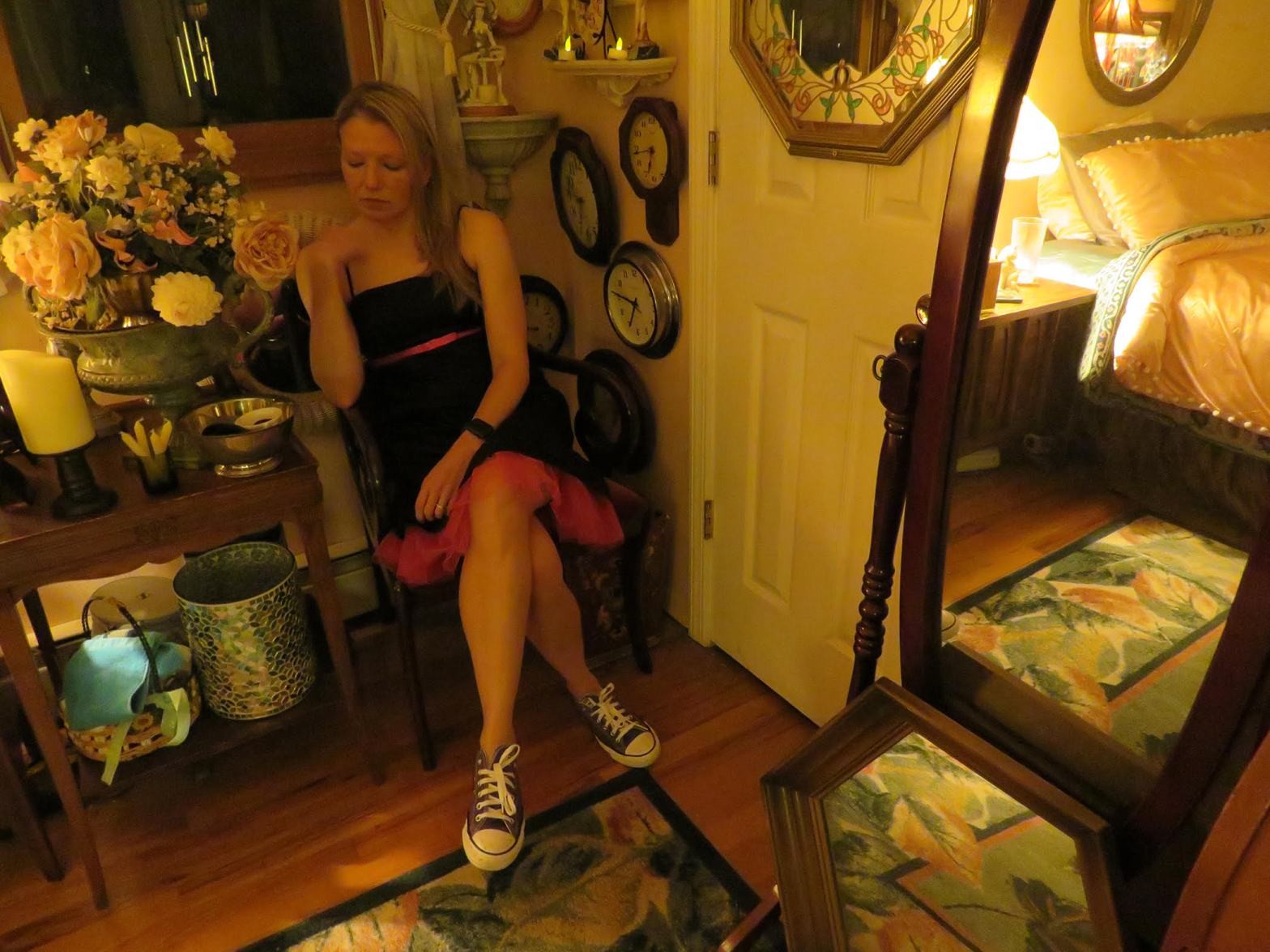
Elizabeth Nelson is the lead singer and songwriter of The Paranoid Style. In addition to serving her duties as a bandleader, she writes about music for publications such as The Ringer, Oxford American, Lawyers Guns & Money, and Pitchfork (including a recent piece on Dylan’s Desire) as well as operating an iconic Twitter account made up of single-tweet album and song reviews that count among the best music criticism of any given year. On the non-music side, she is a researcher on educational policy. Oh yeah, she also writes about golf. It’s difficult to know which of these roles is her main gig and which is a side hustle.
The Paranoid Style’s new album The Interrogator will be released on February 2, 2024. A concept record of sorts and a response to the tone of the band’s previous album, 2022’s For Executive Meeting. As with the best of The Paranoid Style’s music, the new record contains a barrage of funny, yet devastating lyrics delivered at great speed. The Interrogator could be issued with a speed gun as a listener can marvel at the significance of one of Nelson’s lyrics while two more go speeding by. A sign of a good record is when one can say, “This is the key song on the album” and it could apply to four different songs. Such is the case for The Interrogator.
Recliner Notes spoke with Nelson about her songwriting process and subverting rock and roll clichés as well as how her Twitter account and music writing inform her songwriting and much more.
Recliner Notes: When we were going back and forth about this interview and talking about the new album, I described it to you as “more unrepentant literate rock and roll.” You said that unrepentant would be in your obituary. How so?
Elizabeth Nelson: When it comes to The Paranoid Style, we don’t really let up. I mean that in terms of the quality of the rock and roll that you’re going to get served. I think it’s got the hooks and the melodies to spare, but I also feel that [the music] can be punishing sometimes, to have all of these words coming at you in this unending stream of — I don’t think it’s necessarily all negativity — but it can be pretty bleak. It’s part of what’s fun about doing this band and having it as a form of expression. But I think for a lot of people, they’re like, “But we want to have fun and we want to dance!” I’m not saying you can’t have fun or dance to The Paranoid Style, but I do think if you start to sit and focus on the lyrics and in the fashion that they’re coming at you in this rapid-fire way that some people would be like, “It’s too much. It’s enough. Slow down.” So I think unrepentant is a great choice of word. It’s a nice one. I would like that in my obituary, which, if you’d like to write it, I am soliciting submissions. Perhaps soon! I definitely think that there is an element to the wordiness; I feel we’re delivering it in this kind of nice, pokey, poppy way too. It’s not some hardcore band screaming at you.
Recliner Notes: No, I don’t sign on to write your obituary because I imagine that The Paranoid Style will continue long after I’m gone! Speaking of the unrelenting nature of your lyrics, how do these songs start for you? Is it a single line or a concept? Do you have a thesis going in when writing, or do you have notebooks that are just filled with thoughts and they are molded into a song?
Elizabeth Nelson: [My process] is nothing particularly organized. I think it was Lucinda Williams in her memoir [in which] she talks about the great misrepresentation or canard that songwriters have this notebook or they’ve got a legal pad where they start writing and it comes from the initial first idea and everything just spills out from there. Maybe that is how some people work. It’s not how Lucinda Williams works, and it’s definitely not how I work. A lot of times, it’ll be a title that comes to mind first, some kind of catchy malapropism. Not that this is my title, but “Eight Days a Week” or whatever. This kind of thing that you hear and it’s like, “Oh, that’s that’s pretty funny.” Or, a twist on an existing song title. Usually, it’s a joke. Or, it could be like a riff, a cool little melodic idea that comes to mind and then you kind of build out word shapes around it.
There are themes going into each record, like ideas of songs that I want to write about. For example, there’s a song on The Interrogator called “The Return of the Molly Maguires,” which is about a particular group of very feisty and violent union types, who would express themselves through aggressive action and beat up on Pinkertons and stuff. Really the kind of guys you might not want to know, but you also kind of admire. I always thought, “Man, it’d be cool to write about those guys.” First of all, I don’t think they’ve been romanticized too much, although I do think there is a romantic aspect to them, and I think people do admire and respect them in their ways. So that’s a song that’s hanging out there waiting to be written. It’s not like I have a bunch of personal grievances that I want to get out for myself. Usually, there’s ideas of topics that I want to address that then get built around that idea, that funny title. Not that “The Return of the Molly Maguires” is hilarious, but something like “Are You Lonesome Tonight.” That’s a funny title that became a song. It’s like, “That’s a good title, right?” I think there’s a book that maybe has that title from the 80s, but nobody’s really done that yet. So anyway, it’s this convoluted set of ideas. A lot of it happens in the Notes app on the phone. But the legal pad or the shelves of notebooks or whatever, that doesn’t exist. I have terrible organizational acumen, so I would never, ever find any legal pads. I do have notebooks and they’re just tragic.
Recliner Notes: So what is the theme that you had going in for The Interrogator?
Elizabeth Nelson: I mean, things seem pretty bleak. I felt like the last record that we did was pretty fun, kind of our party record — if The Paranoid Style was to party. I just felt like it’s bad out there, and I wanted to talk about that. So I created this character of The Interrogator. I don’t think The Interrogator is good or evil. I don’t know if you watched Reservation Dogs, but there’s a character, a sort of mythical creature that’s called the Deer Woman. And when I saw the Deer Woman I thought of The Interrogator. She’s kind of out there, exerting justice on bad people in a bad, scary way. And that’s [what] I was thinking about: “Who is The Interrogator?” It’s this person who’s holding up a mirror in this scary and violent way and exposing all of this fraud and corruption. [She’s] flying back to her home planet and reporting back and being like, “Ah, it’s just terrible. It’s all bad.” That kind of journey as a loose concept; it is indeed a concept album.
Recliner Notes: That’s interesting. You are as schooled in rock history as anyone and there’s a long tradition of bands and artists who make albums as a response to their previous one. So you think The Interrogator fits into that trajectory?
Elizabeth Nelson: Sure. I mean, I think [the character of] The Interrogator probably likes For Executive Meeting. I think The Interrogator is probably The Paranoid Style’s biggest fan! I think [For Executive Meeting] was just a groovy hang of a record. We just talked about art and artists and the way that we treat them and I think it was important to get back to an original mode of the band. We did a record in 2016 called Rolling Disclosure, and that was like, “Wow, things are really bad, you guys, we better pay attention!”
Recliner Notes: 2015 and 2016 — those were bad years.
Elizabeth Nelson: It was right before Trump because, I remember, I made a joke about Trump. He wasn’t elected yet, but it was at a concert we played, and I don’t think it was received very well. Now, we’re eight years later, and it’s still bad! There’s endless amusements and endless entertainment and I don’t want to be a scold and I know people are like, “Wow, that old lady’s really unfun.” But I do feel like trying to focus on how it’s scary. I don’t necessarily know that I have the answers. We did the fun office culture record. Now it’s time to get back to sort of being a little afraid and being a little scary [laughs]. And as much as it’s an answer to anything, absolutely, we did need to do a course correction. Not that For Executive Meeting needs to be corrected, but just to get away from the jammy, fun hang.
Recliner Notes: Back to the songwriting, in your songs, you work to get lots of words into a line, similar to Craig Finn, Courtney Barnett, Dylan, or Elvis Costello. Do you have an editing or refinement process that you do to get a meter that works for your vocals and the song overall?
Elizabeth Nelson: Absolutely, because a line can look great on paper and then doesn’t necessarily hang in as much as we have a groove. But, yes, absolutely. To be very honest with you, people will be like, “You could probably stand from more editing.” But there is an editing process because a lot of times, words will have to be jettisoned and concepts will have to be reformulated, but part of the fun is cramming all of those words in.
All the people that you mentioned are folks that I really admire who are masters of that craft. For some people, it’s a really tough hang to have to deal with Dylan or Costello or Courtney Barnett or Craig Finn, and how much they try to say. I have a friend who [laughs] can’t stand that kind of Oh-I’m-so-clever-I-just-have-to-have-every-word-in-there phrasing. But it’s something that I love very much and so I try to do right by that tradition. It’s a very specific tradition. Paring things back is something that we as writers have to do, and making every word count is something that I actually do try to do, even if it might not be necessarily apparent on its face to get the point across. So, yes, there is some editing [but], it’s more to make it fit nicely within a meter and a frame.
Recliner Notes: I want to talk about your Twitter account and how it might connect to your songwriting since songs such as “Styles Make Fights” and “The Drop Is Steep” from the new album seem like statement songs about rock and roll. But, also, some of the lyrics in those songs feel as though they could be standalone tweets by you. I’m wondering about how Twitter informs your songwriting, and then vice versa. Or, is it all one continuum for you?
Elizabeth Nelson: Absolutely. The thing that I think is interesting about Twitter and fun about Twitter — excepting all the Elon Musk of it — and copywriting or any kind of journalism within a really tight word count is — and kind of goes back to your earlier question about editing lyrics — making every word count. With Twitter, you’ve got this character count that you have to work within, and so when I’m writing these micro-reviews, they get weird fast because if you’re going to write about a song and you’ve got four paragraphs to do it, that’s easy. What’s hard is getting a big point across in four sentences or in 80 words or whatever. But also part of the fun of doing Twitter is coming up with those little malapropisms and subtle turns of phrase, the little summation sentence that often is playing off of a lyric or a big idea from the rock tradition. And so, yes, I do think that as much as it pains me to say so, there is an overlap and sometimes a great lyric might come from a tweet. And vice versa. I think that while I wouldn’t say that Twitter is the place that I go to get inspired, sometimes it can happen by accident, where it’s like, “Oh, well, that’s actually a good idea, and I’ll just use it myself before somebody else does.”
Recliner Notes: In your lyric writing, you have a number of rock and roll Easter eggs such as “The boys are back in town” in the song “The Return of the Molly Maguires” and, of course, the title for “Are You Loathsome Tonight” to give a couple of examples. But it’s more than an Easter egg, you seem to be using those clichés to subvert them. Is that a conscious and purposeful part of your writing?
Elizabeth Nelson: I think it’s mostly intentional [laughs] rather than happy accidents. But, for sure, stumbling across somebody else’s lyric where you’re like, “Oh, I could subvert that and turn it into my own thing” can happen sort of by accident. With “The boys are back in town” thing, that felt like low hanging fruit. That Irish union fighting type, and, as these things go, [the song] is a bit more of a ballsy rocker. I actually did want the harmony guitars [from “The Boys Are Back in Town”] happening in it, but I couldn’t quite get that over the finish line.
I love Thin Lizzy, so it makes it fun to pay homage to everything that’s come before us and honor them in probably what would be considered a weird way by the artists who came up with those songs. But it’s fun to reimagine somebody else’s lyric. I don’t think that I’m the first person to do it by any stretch. You know, this is something that Dylan does, or Costello, or the people that we were talking about [previously]. Borrowing from the tradition is the tradition; it’s all this continuum. It all comes from folk; it comes from blues.
“Styles Make Fights” is a Bo Diddley song, just more words [laughs]. It’s The Clash and to make an opportunity to comment on rock and roll, which is a very ridiculous idiom. My favorite one that I love very much, but it’s fun to turn it and make it more feminine. Or, make it into a joke a little bit and talk about the overt ridiculousness of the 60s and 70s in the industry. If I can throw in a couple of jokes like that, then I feel like I’ve succeeded. I am thinking about it all the time, so to say, “Oh, it came to me in a dream like a flaming pie”; sometimes awesome ideas come in dreams. But the funny lyrics are usually like, “Oh, let’s poke a little hole in the Don Henley balloon today and see what happens” [laughs].
Recliner Notes: I love that you just quoted a story by John Lennon and used it as a way to subvert the story like you do in one of your songs. Thank you for that! In terms of your Twitter account, you’ve done hundreds of posts. Do you have a favorite?
Elizabeth Nelson: To the real fans out there who have emailed me privately to let me know that I have brought out old tweets again: thanks, guys! [laughs] There are a few that I feel like are the greatest hits, and those are always fun to revisit. First of all, I often will do a little light rewriting on them just to see if I can make them a little better. Gosh, there are a couple that I think are really nice. Obviously, there’s some sentimental ones. The Clash tweets are ones that I like to revisit. There’s a John Prine, “Donald and Lydia” one that I’m quite fond of. Anytime that you bring up The Beatles, people will respond. That’s one that will get heat, not necessarily the kind of heat that you want. You will get thousands of responses that you did not expect. I think that I did a White Album one that I was really quite amazed at how far that went. I thought that was a good tweet, actually. So I’ll stand by that.
Recliner Notes: I remember that one and it was fantastic. I’ll defend it to the end. You do attract the “well, actually” people and that’s not fun. Are there any artists or bands that you’d love to write about on Twitter but haven’t figured out yet?
Elizabeth Nelson: Yeah, I have some inchoate ideas. I actually do have a Google document of half-formed tweets.
Recliner Notes: Amazing!
Elizabeth Nelson: Is it amazing or is it sad? Is this intervention time?
Recliner Notes: No, it’s great. I’ll say this: I wouldn’t know of your music without your tweets, and it’s great to see your own particular mindset reflected in your music and in your writing.
Elizabeth Nelson: Thank you. I take that as a huge huge compliment. Say what you will about Twitter people and how bad it is, but I have come into contact with cool writers, cool people, cool music fans. I complain about the reply guys, but most of the community — if we consider it a community — most of the people are really big enthusiasts. And then they’re like, “I bought your record and it doesn’t suck. Good for you, lady!” And so it’s really nice to do a cross-platform maneuver that I did not expect. So it’s very cool and very validating to know that Twitter sparked interest in the songs and that you can see that it’s all coming from the same beautiful mind.
Sometimes people think [the one-tweet album reviews are] easy to do, and I’m going to shatter that glass and say that it’s really hard. It’s fun. It’s a good challenge, and it’s a good way to keep your brain working. I think people are like, “Well come on out and do the dance. You’re good at this. Write about this album.” That’s not exactly how it works [laughs].
Recliner Notes: The last song on the album — “The Findings” — seems to be a ballad about youth culture. Outside of the band, you are a research specialist on education policy, and this song seems to be from the point of view of a social scientist or a researcher. Were you channeling your other self?
Elizabeth Nelson: I don’t think that’s unfair, and I definitely think research informs most of The Paranoid Style. The idea from a concept perspective is [that it] starts out with The Interrogator, and she’s doing her interrogator things. And then, as I say, she flies back on her chariot of fire and to her home planet and reports back as to how bad everything is in those findings. Definitely, she’s doing ethnographic research throughout. She’s collecting data and presenting it in a summative fashion. And it’s terrible. It’s just terrible. It’s all very sad and the youth culture is fucked [laughs].
I should credit my poet friend [who] submitted some lyrics to that as well. She’s an academic and teaches at UC Denver, and she also knows from having to teach kids all the time about poetry. She and I had a lot of fun working together on it. Two women from an academic background working together to present the findings definitely was informed by my professional side.
Recliner Notes: You sing this great line in the song “The Drop Is Steep”: “Sometimes hobbies get expensive.” You’re a music journalist, you’re an education researcher, you’re a songwriter and leader of The Paranoid Style, so what’s your expensive hobby?
Elizabeth Nelson: Golf [laughs].
Recliner Notes: Oh yeah, we haven’t even talked about golf!
Elizabeth Nelson: Golf and IV drug use, man [laughs]. When you think about the excesses of rock and roll and the casualties it has leveled to friends of ours. I’m sure you’ve seen it with artists that you admire, people that you know, [and] people that you’ve interviewed. You’ve seen it. You probably have consumed bio after bio of multiple stories of Waylon Jennings doing mountains of cocaine in the 80s or whatever. This is an industry that’s really, really tough. And I do think that with that song, in particular, if it is leveling and a critique against rock and roll, it’s that we tend to be a little reckless with how we treat our artists. You’re already dealing with people who might be on the margins, and there’s no safety net to catch them. It can get expensive in a lot of different directions. So, it’s sort of up to your interpretation as to how you want to think about it. But if you want to think about me, probably golf.
 Recliner Notes