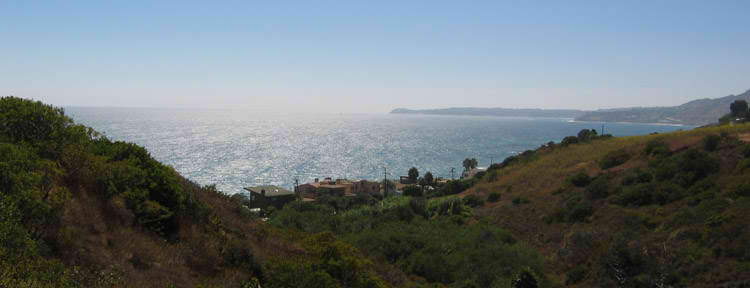
In the latter half of the 1990s, I lived in the greater Los Angeles area, specifically in Venice Beach near the Pacific Ocean. My work was in Santa Monica, so my daily commute was relatively short compared to other Southern Californians. It was also strikingly and stereotypically beautiful. To avoid the traffic of other people also leaving Santa Monica at the end of the day, I drove along 4th Street through Ocean Park, a residential area filled with apartment buildings and a few single occupant houses. Assuredly, the area was upper class, but not an enclave of the super-rich. It was a neighborhood filled with plenty of people walking and biking. But the highlight of this stretch of 4th Street was the slight rise, which was high enough to glimpse the ocean between the buildings.
Even after living near the beach for a few years, I always felt a thrill to see the ocean, especially when moving along at a slow pace in the car. After a few months, I knew to expect and look forward to this quick flash of ocean. I also came to recognize the unique aspect of that view at that specific time of day — late afternoon with the sun not ready to set behind the mountains of Malibu. With the vantage point facing west with the sun close to the ocean, this meant the light danced on the water, fluttering and shaking like leaves in the wind. I soon realized that the light-dappled effect on the sea could be observed not solely from that particular moment of my commute but any aspect of the ocean during that particular time of day before sunset. I then began to seek out and find that moment of the shimmering on the water as if hundreds of thousands of pearls were somehow floating on the sea.
As the years passed and I left California for landlocked environments, this particular image stayed with me. During this time, I was gratified to notice that this natural feature could be observed next to other large bodies of water as long as I was looking west, well before sunset. It needed to have these specifications, but it was pleasing to discover the same scenario and treat myself to this singular combination of light and water. I found it looking west at my parent’s Canadian cabin on Georgian Bay, Jackson Lake at the Grand Tetons, Lake Erie, and with other smaller lakes that I stumbled upon in my travels. So, it came as a surprise to discover that what I thought of as only a visual occurrence could also be depicted aurally.
Papa M is one of a few pseudonyms adopted by the musician David Pajo. Pajo grew up in Louisville, KY, and began making music in that city’s vibrant punk and hardcore scene of the 1980s. He was a member of the short-lived but influential band Slint, after which he played with various bands and musicians. By the late 1990s, he contributed to three unequivocal classic indie rock albums: Millions Now Living Will Never Die and TNT by Tortoise as well as Louisville friend Will Oldham’s first release as Bonnie “Prince” Billy, I See A Darkness. These records represented different types of music of the period, which speaks to Pajo’s varied friendships and connections within the Louisville and Chicago scenes as well as the versatility of his playing.
Throughout this same late 90s time period, Pajo concurrently put out his own music under assorted monikers, including M is the Thirteenth Letter, Aerial M, and, Papa M. 1999 saw the release of Papa M’s Live from a Shark Cage, a beautiful, all-instrumental album in which the longest song is “I Am Not Lonely With Cricket.” The song was recorded in London by Tim Gane of the band Stereolab. In a 1999 interview, Pajo said the following about the track:
“‘I Am Not Lonely with Cricket’ is a simple tune for two guitars. I’m playing along with a sampler pedal, making live loops. The second guitar does the higher sustaining tones. It has distortion and tremolo on it, using harmonics and volume swells.”
In terms of structure, the song is indeed simple. Pajo begins with the track’s signature melody on one guitar and then soon introduces a countermelody. He then proceeds with a series of new melodies and connected countermelodies before returning to the original melody. Though the structure itself may be simple, Pajo’s playing is anything but as the parts are complex and intricate, illuminating Pajo’s musical dexterity and inventiveness.
Listening to “I Am Not Lonely with Cricket” for the first time was a startling experience as, midway through, I realized that it works as the musical equivalent of that image of late afternoon, sun-dappled water that I had carried with me over the years. Hearing the song, I am immediately transported as it conveys the feeling of floating on a gentle, warm breeze over twinkling water. “I Am Not Lonely with Cricket” is an invitation to get lost in a dazzling maze of light.
Even though a song cannot be tangible, it still serves as a form since it’s the result of an artistic process. In a sense, a song can be both defined yet also abstract. With instrumental music, there is an additional layer of indistinctness since there isn’t language to provide context or a singer to set an emotional tone. An instrumental song creates space within its abstractness. It is a container. Someone trying to describe instrumental music rushes in to fill this container with something or anything to provide definition, usually choosing analogies, metaphors, and sometimes life experiences. With “I Am Not Lonely with Cricket,” I’m using my memory of the viewpoint of the Pacific Ocean as well of the implied comparison of a mass of pearls twinkling in the sun even though there’s no way I’ve ever seen that many pearls in one place.
This happens with even the best of listeners as exemplified by the famous quotation by Miles Davis speaking about the playing of his onetime bandmate, the pianist Bill Evans:
“The sound he got was like crystal notes or sparkling water cascading down from some clear waterfall.”
In this lovely passage, Davis makes the abstract notes tangible by including the adjective “crystal” as a descriptor. Then he pulls from personal experience of viewing a clear waterfall to further define Evans’ playing. This characterization by Davis is similar to my own thoughts about “I Am Not Lonely with Cricket” as we both utilize the same “sparkling water” association. Evans is a good comparison with Pajo in the way that they play their respective instruments, namely their tone as well as their use of countermelodies (see Evans’ album Conversations with Myself). In some kind of time travel/alternate reality scenario, Evans would have recorded a lovely piano-version of “I Am Not Lonely with Cricket.”
When I noticed the light on the Pacific Ocean in the 90s, I didn’t know “I Am Not Lonely with Cricket,” Papa M, Bill Evans, and only a little bit about Miles Davis. At some point after listening to Evans, I came across Davis’s description of his playing. Since that time, I think about it every time I hear Evans’s music. For me, Evans’s playing cannot be separated from Davis’s words about him. So, was the lightbulb moment I had associating “I Am Not Lonely with Cricket” with my image of afternoon light on water because of knowing Davis’s description of Evans? Above, I compared Pajo with Evans. Do I only think of that comparison because of Davis’s words?
Putting aside these cognitive questions about how memories, connections, and associations are created as well as thoughts about the facility of instrumental music, “I Am Not Lonely with Cricket” is a gorgeous song by Papa M. The layers of complex guitar playing that undulate and shift throughout the song is captivating. And who knows, maybe other listeners will also conjure up a memory, equate it with an image, or even imagine a certain, gentle quality of light over water.
Image: The original uploader was Khashmi316 at English Wikipedia., CC BY-SA 3.0, via Wikimedia Commons.
 Recliner Notes

what a gem. Thanks for tuning me into Papa M/david Pajo!
Wow
I love this paragraph,
Even though a song cannot be tangible, it still serves as a form since it’s the result of an artistic process. In a sense, a song can be both defined yet also abstract. With instrumental music, there is an additional layer of indistinctness since there isn’t language to provide context or a singer to set an emotional tone. An instrumental song creates space within its abstractness. It is a container. Someone trying to describe instrumental music rushes in to fill this container with something or anything to provide definition, usually choosing analogies, metaphors, and sometimes life experiences.
As a potter you can probably imagine my excitement to think of music as a container of sorts! Thanks as always for this deep dive into some really great music.
LikeLiked by 1 person