
Listening to a song written by Ryan Davis for the first time can be an exhilarating, yet overwhelming experience. His songwriting features a cavalcade of images, wordplay, metaphors, and jokes that come in a rush. It’s similar to flipping too quickly through a book of photographs by William Eggleston. The abundance of color and outlandish juxtapositions in Eggleston’s work can result in overlooking his extraordinary eye for detail. The same is true for Davis. Every line in one of his songs demands repeat listening. Each is strong enough of a concept to be its own separate song. Davis’s “Bluebirds in a Fight” is the epitome of his songwriting approach:
“Bluebirds in a Fight” is featured on Davis’s 2023 release Dancing on the Edge, the first album issued under his own name along with a crew of musicians dubbed The Roadhouse Band. It begins with Davis singing by himself, backed only by an acoustic guitar. Soon, a piano and a steel guitar enter to provide support and occasionally emphasis. The stripped down arrangement during the first half of the “Bluebirds in Fight” recalls “I Contain Multitudes,” the opening track of Bob Dylan’s 2020 album Rough and Rowdy Ways. Besides sharing similar instrumentation — especially the use of a steel guitar for accent work — the musical presentation of both songs is a deliberately constructed platform to showcase lyric-heavy songs without choruses. Davis might have taken a cue from the older songwriter on how to best present a “gift of gab” songwriting style.
Against this musical backdrop, Davis begins by singing, “These are your nuclear provisions.” This is an amusing way to open a seven minute-plus, lyrically-dense song to suggest that what’s to come is comparable to a complex series of agreements to regulate nuclear weapons and power plants. Conversely, the line also suggests that the words in “Bluebirds in a Fight” are so elemental and necessary that they can be felt at the nuclear-level of our DNA. Davis seems to understand that his songwriting has the potential to inspire multiple interpretations because he goes on to sing: “The past is a joke played on the future by the present.” Trying to untangle the logic behind this line is challenging, but then he goes on to sing, “The future’s a joke played on the present by the past,” seemingly pulling the rug out from under the previous declaration. Davis himself is sorting through the varying possibilities regarding the nature of time. Ultimately, there’s no correct answer except that someone is pulling a prank and separating the prankster from the one getting pranked is only a matter of perspective.
“Bluebirds in Fight” is infused with reflections on aging and mortality. It’s no mistake that the first time a female voice enters the song to accompany Davis, it’s to harmonize on the line “It’s a private decline.” This serves a point of emphasis that life is not only a decline that we endure by ourselves. He also sings, “A barreling forward / Toward some form of bold new sorrows.” This is someone trying to both talk himself out of a grim destiny while also reluctantly accepting what’s to come. The song’s narrator is grappling with the inevitability of death, which, going back to the opening verse, is some sort of cosmic bad joke that’s both painful and wryly funny at the same time.
From here, the narrator continues to try and describe aging by substituting different phrases in for “a private decline” or “a barrelling forward.” He also offers: “A quiet descent into fertile ground” and “a primal design and it’s gated in pearl.” It’s as if the narrator can’t settle on the right metaphor, but he’s going to keep trying, dammit.
One image that is intentional on Davis’s part is his usage of the bluebird. Dating back to ancient mythology in Chinese and Native American cultures, the bluebird has been accepted as a symbol of happiness. This has continued into American pop culture with the song “The Bluebird of Happiness,” recorded by tenor Jan Peerce, which sold millions of copies and was subsequently covered by many different artists. For Davis, the bluebird is a more complicated emblem than pure happiness as his bluebirds are, in fact, in a fight. He describes this conflict as “A private concert from the daybreak band,” indicating that, at first, he thinks the sound of two birds at sunrise is a performance that only he is privy to. Then there’s a realization that the bluebirds are having a mid-air altercation. Perhaps the twist on the bluebird as a representation of happiness is a recognition by Davis about the struggle that many face trying to attain pure state.
Another popular song referenced in “Bluebirds in a Fight” is “I’ll Never Get Out Of This World Alive” by Hank Williams. Williams recorded the song in 1952, the year before he died at the age of 29. The song is an ironic acceptance on Williams’s part of the self-fulfilling prophecy that his hard-living lifestyle would result in an early death. Davis inverts the title phrase of Williams’s song by singing, “I’m just trying to get out of this life alive.” This line once again connects with Davis’s reckoning with mortality throughout the rest of the song. Furthermore, despite the weightiness of the theme, Davis piles his own irony on top of the original irony of Hank Williams to set a new amusing aspiration for his survival.
In addition to the alteration of the Hank Williams line, “Bluebirds in a Fight” is laced with many other humorous lines, most likely as a way to off-set the serious subject matter. One example is this entire thread:
I saw the trash collector piss in a cup
You know it happens but you never get to see it
Like a slasher flick victim taking time
To spell out “help” with the drip of their blood.
It’s two hits in a row by Davis; first is the realization about garbage collectors needing to relieve themselves, and then the amusingly gruesome simile about our collective gullibility of movies, books, and television telling us that wounded people can somehow plead for assistance in their own blood. Later in the song, Davis has another perfect metaphor, namely the “wet paper world’ that “we can try but we can’t fight our way out of.” In this line, Davis illustrates that our world has the same impermanence as a soggy, damp paper towel, but we’re powerless to break free of it. These whimsical reflections by Davis further evokes the comparison of his songwriting to the photographer William Eggleston.
In his wonderful book-length photography survey The Ongoing Moment, Geoff Dyer writes that Eggleston’s work proved “Vulgarity, if approached with sufficient technical and aesthetic refinement, could be beautiful.” Dyer goes on to say that Eggleston’s photographs’ “subtle proximity to banality was crucial…to its disconcerting, enigmatic power.”
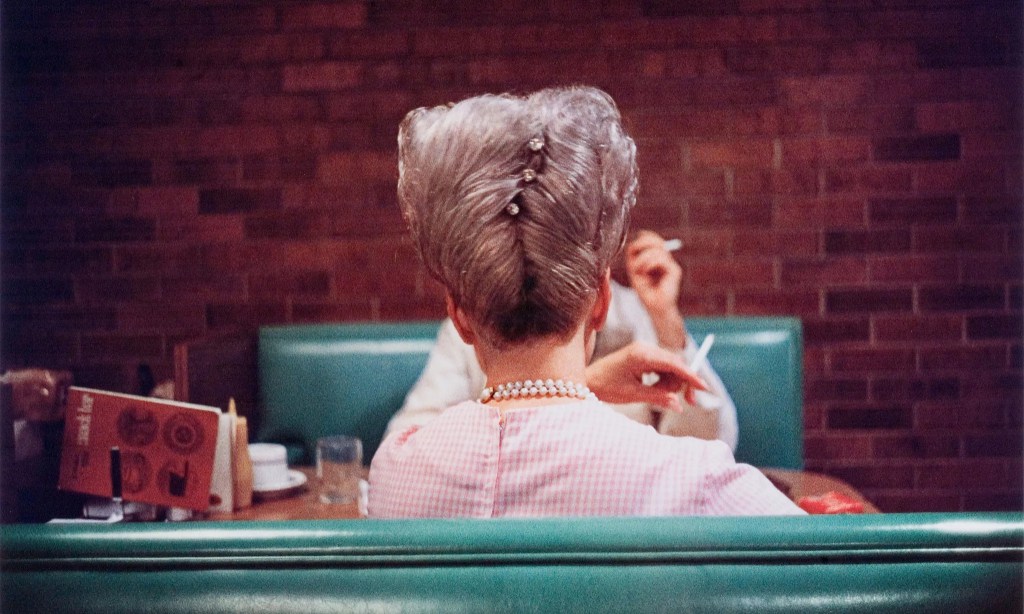
Like Eggleston, Davis is comfortable trafficking in vulgarity; the verse about trash collector pissing into a cup and the comparison to slasher victim spelling “help” with blood is one obvious example. Also similar to Eggleston, Davis is able to create beauty despite his sometimes crude imagery because of his focus on details; those parts of our world that we all see, but never actually notice. He presents these observations through absurd adjacencies such as “Could you sit there and watch me pull a sword from the stone / Just to keep the cable on”; “But you don’t always get the kind of help you need in time / From ‘help’ written in blood”; along with the other previously quoted lines. Davis’s “technical and aesthetic refinement,” to borrow Dyer’s words again, is demonstrated through his command of language to create a strange and funny type of beauty.
Another compelling aspect of “Bluebirds in a Fight” is the structure-free melody of the song. It is reminiscent of the type of songwriting that Davis did with State Champion, his band before going out on his own with Dancing on the Edge. When asked in an interview about the unusual song formats of State Champion, Davis laughingly responded:
“I never really realized our song structures were that crazy until recently, when a band I liked came to town and I couldn’t get all the State Champion guys together for a show…So I put together a sort of makeshift band to play with, a scab version of State Champion. I would get these great guitar players in town, people who I knew could just sit down and figure these songs out, a cast of great musicians who I admire. I got them all in a room and said, ‘It’s just D-A-G, it’s really simple, all the songs are kind of the same….They were like, ‘I don’t know how the fuck you play this shit. It doesn’t have any logic to it.’”
“Death Preferences” from State Champion’s 2018 album Send Flowers is a good example of this tendency:
Most of the songs on Dancing on the Edge employ a consistent song structure. However, “Bluebirds in a Fight” is more akin to the State Champion strand of songwriting. Its melody makes complete sense when Davis sings because any given word or line is connected to the emotion that he is trying to communicate. Recalling the variations on the phrase “a private decline,” in each instance, the melody changes to a minor chord. This darker tone to the music suitably reflects Davis’s meditation on aging and mortality. The melody is dependent on the words and vice versa while also acting as a musical clue to the listener that he is returning to this trope. Even though “Bluebirds in a Fight” may not adhere to a traditional song structure, it contains an emotional coherence through the alignment of melody and words.
“Bluebirds Revisited” — the final song on Dancing on the Edge — continues the same melodic and lyrical mutations as “Bluebirds in a Fight”:
It’s hard to say if “Bluebirds Revisited” is a sequel to “Bluebirds in a Fight” and it presents another opportunity to return to the themes of the original song. Or, perhaps the initial draft of “Bluebirds in a Fight” was too long and Davis chopped off the ending to create something new. “Bluebirds Revisited” continues the ruminations on aging and death, containing phrases such as “I’m just trying to get to heaven or whatever you’d call it” and “Barreling forward while my memories riot behind me.” The extravaganza of Egglestonian details also abound (e.g., “I’ve been pourin’ soda pop on the compost for the natives”; “I’ll leave my roadmaps in a drawer and explore / Where the asphalt’s still smeared with the deer of the nineties”; “Happy hours are subject to market price”). Towards the end of the song, Davis sings:
These are instructions for disposal
Of my own miniature private mankind
These are instructions for disposal
Of my dick
As compared to my mind
Of my dick compared to my mind
My dick compared to my mind.
The narrator is mulling over the end of his life, but can’t resist making a dick joke, another obvious instinct towards vulgarity. He recognizes this inclination by singing, “It’s a joke played.” The line is echoed by his female vocal accompaniment and Davis finishes the thought with “A joke played on the future of man.” There’s a pause and he sings, “Bluebirds out of time.” These traditional symbols of happiness are no longer fighting. Instead, they have relented, risen above their conflict, and have finally ascended beyond the trappings of this world, bringing some sort of acceptance to the song’s narrator. However, after Davis sings this last line, “Bluebirds Revisited” ends with a minor piano chord. It’s certainly a melancholy touch, but also seems to bring this final lyrical acceptance into question. It’s an uncertain, yet beautiful way to end the album.
“Bluebirds in a Fight” and its sequel “Bluebirds Revisited” are two examples of Davis’s distinctive songwriting displayed throughout Dancing on the Edge. Through his overwhelming presentation of lyrical acumen, an uncanny eye for detail, and his ability to imagine laughable juxtapositions and absurd possibilities within the face of death, Davis’s songwriting voice embodies an “enigmatic power” and beauty.
Image: Bluebirds with Morning Glories and Lespedeza, woodblock print after Katsushika Taito II, late 19th century, Dayton Art Institute, Hiart, CC0, via Wikimedia Commons.
 Recliner Notes

2 thoughts on ““Bluebirds in a Fight” & the Songwriting of Ryan Davis”