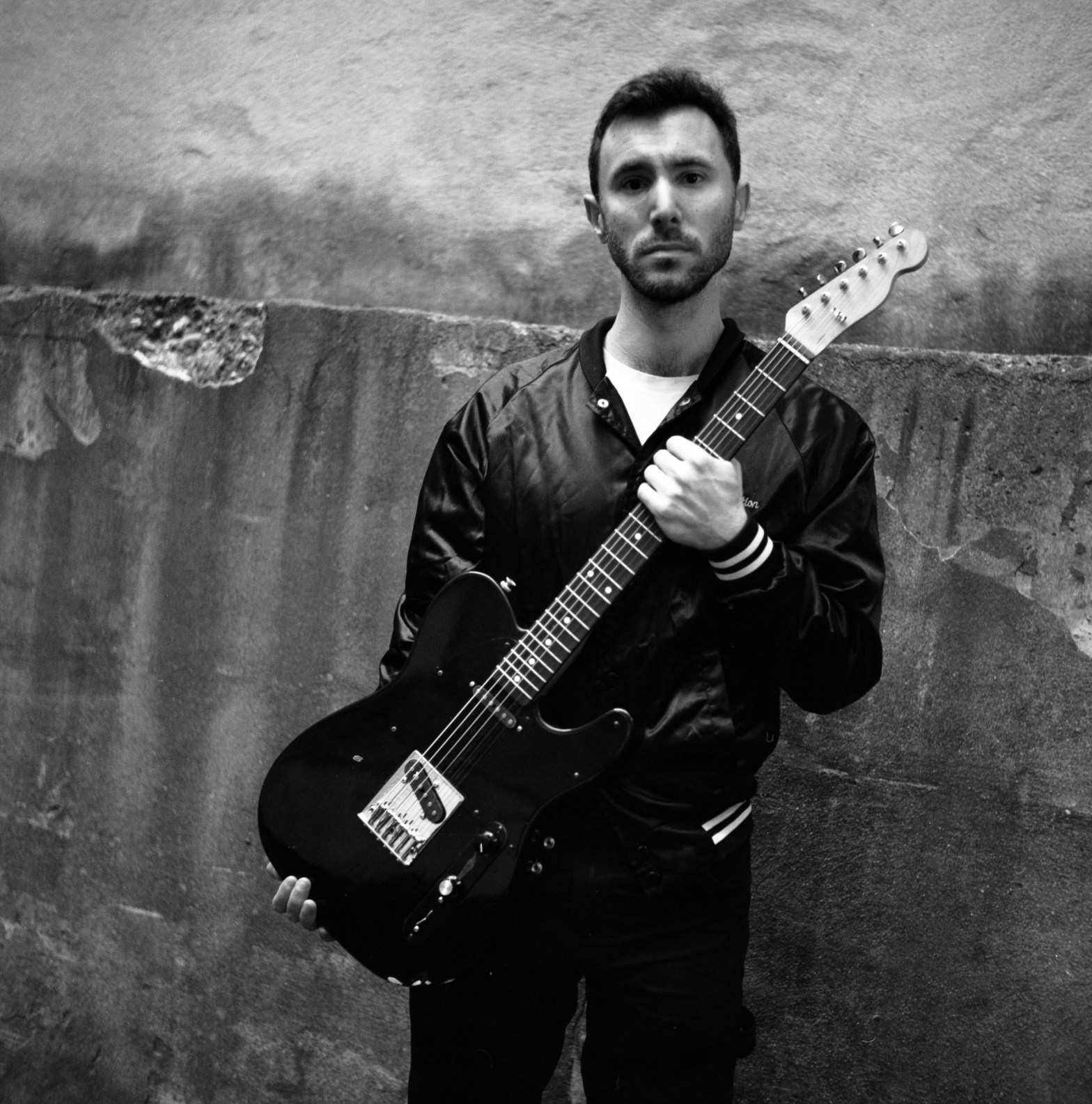
Eli Winter’s A Trick of the Light was one of my favorite albums of last year. Winter’s previous work had demonstrated his artistry, virtuosity, and unique musical perspective, but the 2025 record advances Winter’s vision further. It’s a tour de force throughout as Winter presents a sweeping musical portrait of his regular band — Sam Wagster on pedal steel and drummer Tyler Damon — as well as an inspired slew of special guests.
The highlight of A Trick of the Light is the opening track, an outstanding performance and recording of Don Cherry’s “Arabian Nightingale.” The pedal steel of Wagster sounds like a nightmare come to life while Gerrit Hatcher’s saxophone could be mistaken for Bill Pullman’s free sax playing in David Lynch’s Lost Highway. In fact, the entirety of “Arabian Nightingale” could be the Lost Highway soundtrack. I’ve returned to it as much as any recording from the last year.
Curious to learn more about Winter and his process behind A Trick of the Light, I interviewed him a few weeks before he and his trio embark on a spring tour. We discussed his high school letter to Cory Rayborn of Three Lobed Recordings, alternating between acoustic and electric guitar, his partnership with Cooper Crain of Bitchin Bajas, and much more.
Recliner Notes: Growing up, was guitar your only instrument, and if so, when did you start playing?
Eli Winter: No, I sang as a young kid, like pre-elementary school, and I played piano. I studied classical piano in elementary school and classical clarinet in middle school. The high school that I went to is a small public high school in Houston, and they didn’t have a music program, which is actually a plus because I did not want to continue clarinet. I did not want to play in marching band or concert band, for that matter. So, I started teaching myself guitar in high school. That would have been around 2012 and so just went from there.
Recliner Notes: Fast forwarding a little bit, I read that you pitched yourself to Three Lobed when you were in college.
Eli Winter: Actually, in high school.
Recliner Notes: In high school! Tell that story.
Eli Winter: I was just a boy who cared so much and still does. In Houston, I didn’t have a lot of music community. I started off playing the instrumental parts of other people’s music, like Nick Drake or Elliot Smith. I really wanted to learn Sonic Youth’s and Pavement’s music, but the guitar tunings weren’t going to work on a tiny little acoustic guitar. Eventually, I started discovering Steve Gunn, Jack Rose, Daniel Bachman, and other folks, but those three were some of my biggest touchstones at that time. Really still are, too. It was after writing to Steve and Daniel and getting really kind responses back, which I wasn’t exactly expecting because, like I said, I was a literal boy. I wrote to Cory, and I said something like, “Hey, I’ve been talking with Steve and Daniel, and I’m doing sort of a similar thing. Maybe we could do this sometime, too.” And because Cory is a really kind guy, he wrote back and was like, “Yeah, you never know. Keep it up. It’s good that you’re talking to those guys.” And that was all I needed. This was when I was keeping a Google doc of record labels who take unsolicited demos and attempting to submit phone recordings because I didn’t know how recording worked. I still don’t really know how recording works [laughs]. When I had no frame of reference for the logistics of the process of putting music out, I still had this sense — with Three Lobed, for example — of this label that seems to be run by a kindred musical spirit, and I didn’t necessarily know how much of that there might be. I think that was the unconscious process.
Recliner Notes: How did you get reconnected with Cory? Did you feel, “Okay, now that I have a body of work, I’m ready to put myself out there again”?
Eli Winter: We’d stayed in touch, and I kept working on music and trying to help the label in other ways. I wrote a couple of local album reviews of Daniel’s albums. I made sure that my college radio station got Three Lobed CDs — small things like that. But then I sent him my album called Unbecoming, which American Dreams put out. There was one band song which is pretty immediate, and then, on either side of the band song, are these two quite long, abstract — music that didn’t offer quite as many handholds as the comparatively warm, light-hearted quartet song does. Cory heard that album and said, “Hey, that band song struck a chord” — pardon the pun — “How would you feel about doing a band record?” That began the process that led to the self-titled album and on from there.
Recliner Notes: I’ve got some questions that are related to that full band sound. I think that in A Trick of the Light, as opposed to some of your earlier work, the guitar actually seems to be less upfront. You’re providing a full portrait of the band. Do you think that’s accurate? If so, was it a conscious decision on your part?
Eli Winter: I think it’s accurate. I think it’s maybe intentional but unconscious. There was a time when I thought I wanted to be the best guitar player — whatever that means — in a certain idiom. That was informing a lot of the first couple albums. I guess it also informed the Anticipation album I made with Cameron Knowler. Maybe this has to do with creative nonfiction training and the way I tend to approach writing prose. With my own natural relationship to attention, I’m not really interested in playing guitar solos. And I’m not really interested in taking up space with my own playing, for its own sake, through sheer technical virtuosity. I believe in the songwriting. However foolhardy the belief is, I also think of the music as songs rather than as instrumental pieces. I think because the guitar parts that I end up playing tend to operate as if they have a vocal line. Other people might be more comfortable orienting the arrangements of a given album around their guitar playing. Especially playing with my dear trio bandmates Sam and Tyler, they bring so much to the music and what they do is so simultaneously specific but also kindred. It feels like we’re all working towards a common goal, and the common goal happens to be music that I, for the most part, write or arrange. That mostly means that I’m thinking about whatever makes the best possible song with a larger scope. I feel pretty bound by technical limitations. There’s a lot I can’t do. At the same time, there’s a lot I know I could do that I don’t need to put on a record.
I know I can do a given thing, but I’m never thinking about the way I play guitar in terms of translating patterns, whether my right hand or my left hand. Maybe this is because I’m self-taught, but the music is coming more from a place of exploration. As someone who did not study chord shapes, I did not consciously say, “Today, I’m going to play every version of a C chord and bar it going up the neck 12 times.” I can do that, but I didn’t consciously study that. It just came about through learning the music I wanted to over very long periods of time and returning to it. That’s what gave the foundation for my playing.
I think that all comes to bear on how my more recent music has taken shape and continues to take shape. The thing that feels most important is always that the music is as moving and/or effective emotionally as possible, rather than that I play in a pyrotechnic manner. Given that I both feel discomfort with certain kinds of attention and simultaneously don’t feel the need for it, playing music is very much a learned behavior as a result of the confluence of those two things. But my goal when I’m playing a concert is always to play the most moving music that I can and really so simple as being myself, but in a way that uses my own natural aptitudes and tendencies and doesn’t try to simulate things that don’t feel natural. As a result, I think about the arrangements in the music pretty much in the same way. I’m not trying to be anything I’m not. To me, it feels more interesting and more challenging to get to the kinds of places I want to go in the context of arranging parts around the core trio as opposed to if I were to make a purely solo guitar album. I could do that, but I’ve already done that. At some point, I might want to again, but it would need to be different in some way.
Recliner Notes: You made an interesting comparison to creative nonfiction writing. What’s that connection? Can you clarify that?
Eli Winter: I studied it in college, and so I think that, inadvertently, the way I approach writing a song, or even constructing a song has some similarity with how I’d approach writing or constructing a piece of prose writing. I’m approaching it with similar aesthetic interests, I suppose. Not necessarily doing it as well, but that’s part of the point.
One of the things I learned in my nonfiction training is that the structure of a given piece is often determined by the piece itself, like a vinyl record determines the length of a given side of an album. You might be limited by a certain word count. Or maybe you’re doing some weird Raymond Queneau thing and you’re removing the letter “E,” which is especially hard if your last name is “Queneau” [laughs]. There might be limitations, but like pouring water in a certain container, it might have the same amount, but it takes up a different shape, depending on the shape or dimensions.
Separate from the process of writing music for instrumental music, I’m often thinking about music in terms of its structure, to the extent it has one, because oftentimes it doesn’t. Or, if it has a structure, it might not be the “verse, chorus, verse, chorus, bridge, first verse” kind of thing. It’s where I can have the awareness of that and then happen to set it aside, seemingly anytime I produce an actual song of any sort. When I’m bringing music for other people to work on, I’m often not consciously aware of what the structure might be or what the rhythm is or what the time signature is. It’s all things I’m aware of in my experience with music, but not necessarily intellectually. I have to think about it in order to figure out, “What signature is this song in and what are we doing here?” Occasionally something emerges and it sounds a lot like another song. That’s not intentional, but if it happens, then I can figure out the best way to make that work within the context.
Recliner Notes: Similarly, you alternate between electric and acoustic guitar and even on A Trick of the Light’s “Black Iris on a Burning Quilt,” you’re over-dubbing both. And then a lot of those songs that were acoustic on the self-titled album, you presented them electric on the live album A Day Behind the Deadline. How do you choose between electric and acoustic, and what do each offer?
Eli Winter: It’s, ultimately, a practical choice. I play a [Martin] D-18 that does not have a pickup or an input, so I need to use a microphone to play with it. You can only raise the volume a certain amount before you start feeding back, which means that it is difficult to play with the band. I’ve done that a couple times with other folks in band situations. So, playing electric guitar is pretty much a natural development from that circumstance, though I have often found myself beginning music on acoustic guitar then translating it to electric, which I do really like to do.
It’s funny, “Black Iris” actually has cittern rather than guitar. It’s left-handed cittern. And that’s Kiran Leonard, brilliant British musician and friend who plays seemingly every single instrument you could possibly name. I didn’t even know that left-handed cittern conceptually existed until he was like, “Yeah, I’m playing left-handed cittern.”
So, it’s partially the practicality and partially the fact that I’m already more interested in band music. Probably that will persist. Acoustic guitar is there, and it’s helpful for other things. I’m very slowly working on a singing record which has acoustic guitar at the foundation. It’s also pretty much a function of what I’m interested in as much as what is practical for a live setting.
I think if I’d have been able to play the self-titled album [material] live with an acoustic guitar and just run that through an amp — probably there’s a way to do that, I just didn’t want to. Now I’m able to explore so many more different possibilities with the electric guitar: being able to change different dimensions of the tonal quality or the way that the guitar is equalized. Whereas the acoustic guitar, part of what’s so nice about it, is the way I tend to play out live. For the most part, I’m not using pedals, and that means that it’s the clearest representation of the sound. Ideally, that’s what’s going out into the crowd as if I’m just playing here at home. Ultimately, it’s practical and a function of interest.
Recliner Notes: I want to ask about “Arabian Nightingale” on A Trick of the Light because it’s a remarkable recording. You recorded a solo version of the song for Aquarium Drunkard back in 2022 after your self-titled album. When did you know you wanted to do a full band arrangement of it and what was the inspiration?
Eli Winter: Funny enough, it was also somewhat practical. It made sense for Tyler and I to play it together as a duo and then it made sense for Sam, Tyler, and I to play it as a trio. I happened to have recording sessions booked in January ‘23. The nature of the sessions had changed completely due to forces out of my control, and I was under a lot of stress. Part of the way that I chose to move forward with the sessions was that I’d been talking with Andrew Khedoori, who ran Longform Editions, about doing a piece for them. I’d entered the studio with the intention of recording with a quintet, stitching a bunch of little ideas together and then it’d be easy to do. I’d continued to hear ideas for saxophone, for God knows what reasons. I wasn’t sure how to manage all these different ideas. Most of the session was actually a total abject failure, except for the bits and pieces that I could stitch together into what became the Ghost Notes music that you hear on that Longform release and “For a Fallen Rocket” and “Arabian Nightingale.”
The reason that those particular players are on that song is because Sam and Tyler have obviously played together a bunch and have a really strong musical connection and connection as close friends. Tyler had played with Andrew Scott, who plays bass throughout the album, and Gerrit Hatcher, who plays sax, in a separate improvising trio. I’m a huge fan of Gerrit’s playing and Gerrit’s tone in particular. So, it made sense for us to go to the studio together because we’d already have some amount of inborn chemistry and rapport.
That song made sense to run because I thought it might help us develop that connection as a quintet. We had a few takes of it, and, what you hear on the record is, thankfully, mercifully, just the take itself, not edited at all. It’s funny, it took a little while for me to figure out how to arrange it because I had it in the wrong key. Once I found out what key it wanted to be in, it became a lot easier to play. I had done some arranging for the Anticipation album with Cameron Knowler, but that music was comparatively more straightforward because it was our two approaches to playing guitar coming together, more or less 50%-50%. The process of that music was quite a lot more straightforward than, for example, “Nightingale.”
“For a Fallen Rocket” was the same way. Originally, I had thought that was going to be part of the Ghost Notes project, but then it ended up being so strong that it wanted to be a standalone piece of music, which then meant I was leaving the session feeling like I’d totally bombed everything, except for these 20 minutes of music. I didn’t think it would be the first half of [A Trick of the Light], but “Nightingale” felt too long. And even though it might not have made the most sense to an empty suit at Spotify or something, it ended up feeling like it brought the strongest record to bear. It was really just a happy accident.
Recliner Notes: So, there’s the “Arabian Nightingale” happy accident, but then you also recorded Carla Bley’s “Ida Lupino” for the album. What do covers provide for you? Is it a sense of distance as opposed to creating your own melodies and compositions?
Eli Winter: The Anticipation album has a traditional folk song arrangement and two other arrangements: Tut Taylor and Michael Chapman. But we translated the music pretty much within the same idiom, but looking at it from a different angle. Whereas this is quite different because “Nightingale” is originally a three minute long duo for piano and pocket trumpet and “Ida Lupino,” of course, has been played 100,000 different times. The rendition that was connecting the most with me was the Paul Bley Trio’s Closer arrangement from 1965. That’s a song that Tyler suggested that we play. He thought it would make sense, and he was right! That song arrived when I really needed a song to shepherd me through a sort of comically difficult fall and winter of ‘23 going into ‘24.
As far as your question more broadly, I think there’s a lot to learn from setting other people’s music and finding a way to interpolate it in your own way. I guess this is not dissimilar to the method of teaching writing by imitating other people’s work. At the same time, there’s some overlap between that kind of choice and something like The Beatles might have had in the early ‘60’s playing a bunch of other people’s music and putting it in their own forms. Of course, there are plenty of other bands who do that before them and since as well.
I would rather a record have a strong arrangement than a half-baked song that I write. This is something that I feel strongly about. Sometimes the music that I really like is that which I don’t understand. Some of my favorite singers have albums with music that a handful of songs I connect with on such a profound, visceral level of my body, and maybe 75% of it, I’m thinking, “I don’t understand this at all.” It doesn’t mean it’s bad. This means I don’t get it. In my perspective, a song that you don’t understand is offering you more than a song that just feels like there’s no care or intention behind it.
There was a part of me that probably unconsciously felt that leading the album off with a 17-minute long song that I didn’t write — I was like, “Is this career suicide? I think so!” It’s such an immediate recording and there was a part of me that was feeling like it just had to happen that way. And if anybody felt differently, they could shove it up their ass! Seriously, because I think there’s so little money in the music industry that working artists are able to receive, I think it is really dangerous to make compromises of the work that you want to produce for the sake of trying to chase 50 more dollars, especially if it’s 50 more dollars you’re just going to recoup in expenses that you might never recoup. But the next second I’m like, “Maybe a lot of short songs is a good idea!” So, it’s a bit of jumping back and forth between those poles.
Recliner Notes: I interviewed Cooper Crain of Bitchin Bajas for Aquarium Drunkard last spring to talk mainly about the amount of production and engineering work that he’s done over the last couple of years. I think there’s a real warmth to a lot of the records that he works on. That was before A Trick of the Light came out and I thought, “Wow, this is that same sort of sound.” So, how’d you meet him? How did you begin working with him? And what do you think about my idea in terms of the sound that he’s able to generate?
Eli Winter: Oh, I agree, as far as I can tell. Sam connected me with him because I was interested in working with him for the self-titled album. We’ve been able to work together a good number of times since. We’ve been able to get into a good workflow and become friends through that process, which I’m really grateful for. Like so many people who I play with, he’s somebody who I’ve looked up to as well.
Working at [Electrical Audio] produces certain qualities of recorded sound that would be different in other studios. [Cain] prefers to work there, because, as I recall, he told me that everything works! I think the work that we’ve made has been unmediated in terms of what you hear, is what you get. I think if there were interest in processing things more, we could do that too. But for him, it tends to feel, at least in the albums we’ve made together, like you’re working to realize the existing music as much as you can. I think that A Trick of the Light does that even more effectively than the self-titled album. I think part of it is because of circumstance. The self-titled album came about under a really, really tight deadline, and the overdubs were coming in down to the wire, about as literally as that capacity can be meant and reviewing mixes remotely in that stress. Everything turned out fantastic, but there was a bit more separation in that process with A Trick of the Light. I was able to just hang out with him at his place and he could mix. Every so often, I might futz with something on his computer to arrange tiny little pieces of audio or something.
I don’t think the warmth in the sound is necessarily something either of us are actively searching for in the process, but it’s definitely something I tend to want in my music. It seems as if it’s something that he gravitates towards in his own work, for whatever reason. If nothing else, that’s sonic common ground that we share without necessarily realizing it and certainly having never talked about it.
This interview has been partially edited and condensed.
Photo: Beth Kotz
 Recliner Notes