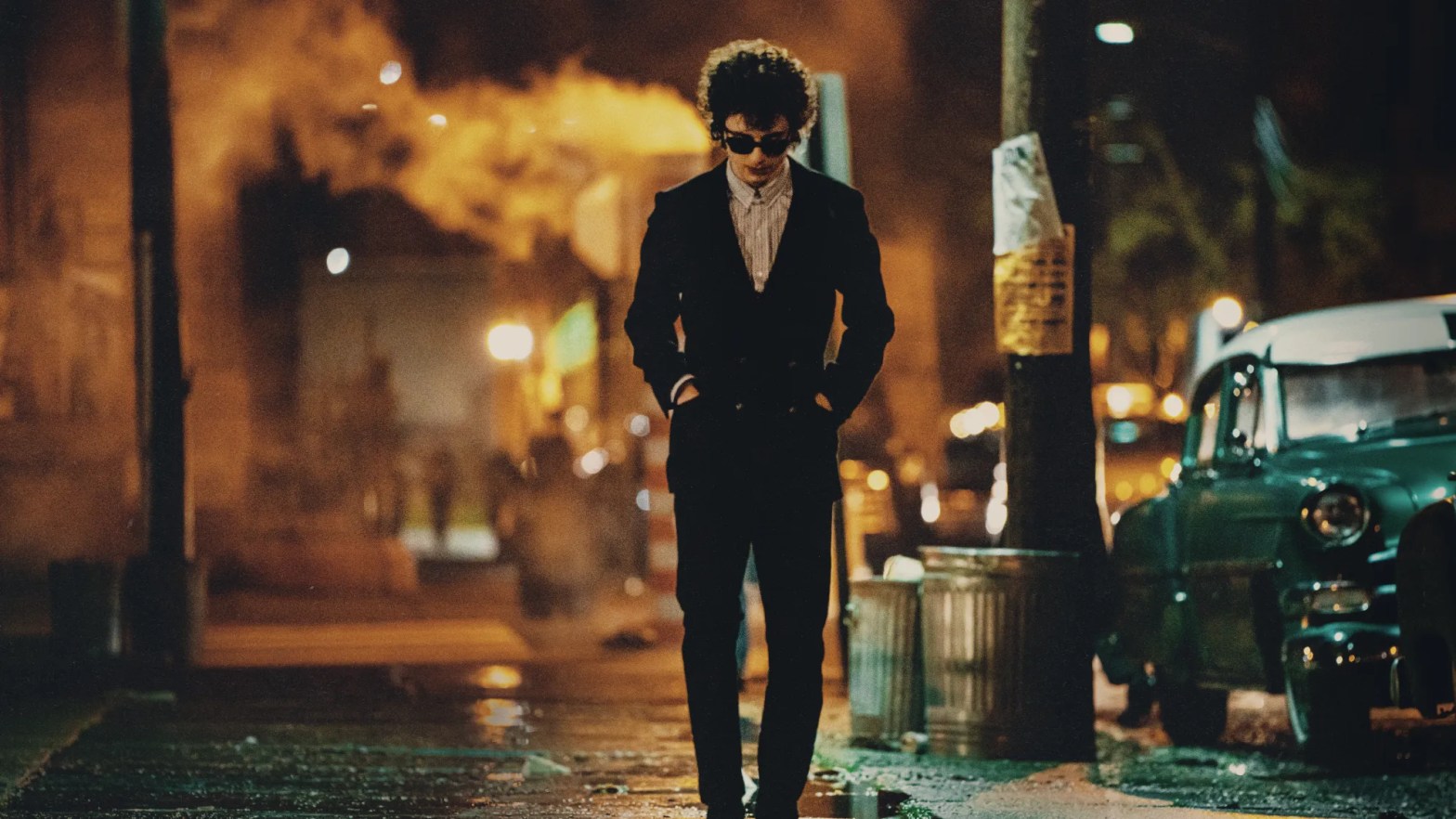
A Complete Unknown — the 2024 film about the life and music of Bob Dylan between the years 1961 and 1965 starring Timothée Chalamet, Edward Norton, Elle Fanning, and Monica Barbaro — was not made for me, at least not for people like me.
Biographical films about musicians, also known as music biopics, are not made for obsessives, specifically those who want to know the history beyond the songs. We seek out stories in the music section of book stores and devour interviews, not only with the particular artist, but also with the producers, session musicians, and witnesses. Biopics function as introductions for a general audience, the 101-level class, while the music freaks feel as though they should be teaching the class.
Music biopics attempt to demonstrate what makes an artist so attractive, offer as much context as possible, showcase the music itself, and still try to present a compelling narrative portraying several years or even a lifetime in as close to a two hour runtime as possible. This leads to rushed scenes or lazy writing. My favorite examples are from Oliver Stone’s 1991 film The Doors:
So much has been crammed into this three minute long scene that it no longer sounds like two people having an actual conversation, but rather a Wikipedia entry about the time that Ray Manzarek and Jim Morrison were reacquainted on the beach and started The Doors. It’s so laughably generic and filled with clichés. Kyle MacLachlan is instructed to say the following with a straight face: “Vietnam is right out there, MAN!”
I thought music biopics as a form were made redundant after 2007’s Walk Hard: The Dewey Cox Story:
Everything about Walk Hard hilariously and masterfully satirized the genre, seeming to make any music biopic afterward dead on arrival. When A Complete Unknown was announced, my first instinct was to assume that the movie would include dialogue such as “The Sixties are an important and exciting time.” It was easy to feel this way since the project was directed and co-written by James Mangold, who had already contributed the Johnny Cash story Walk the Line to the music biopic oeuvre, the most direct target of Walk Hard’s skewering.
The site where this very review is being published is proof enough that I know waaaaaaay too much about Bob Dylan. I seriously entertained the notion of entirely skipping the movie, but my family was intrigued by it, especially my teenage daughter Stella. In fact, her Christmas gift to me was for us all to see A Complete Unknown together.
Given that we were traveling and unsure when or where we have the opportunity to screen the movie, we joked that her gift to me weren’t actual tickets or a gift card, but rather permission to see a Bob Dylan movie together. I gladly accepted that present and did my best to not read reviews and shed preconceptions about Walk the Line, Walk Hard, and many years of Bob Dylan obsessiveness to watch A Complete Unknown with an open mind and open heart.
In short, it’s pretty good! It certainly lives up to the promise of providing a compelling, and even sometimes thrilling depiction and introduction of the myth of the young Bob Dylan, the wonder boy who wrote “A Hard Rain’s A‐Gonna Fall” at the age of 21. Of course, it climaxes with the “Dylan goes electric” legend from the 1965 Newport Folk Festival. I admit that the movie has stuck with me longer than I anticipated and continue to think about details from the film as well as decisions by the filmmakers.
The following are some highlights by the open-minded, open-hearted father watching A Complete Unknown with his family:
- Chalamet was excellent! His singing was unexpectedly engaging and guitar playing was good enough. Most of all, he was able to credibly portray a public figure that is so widely well known that Bob Dylan impressions are now considered hacky. Every now and then, his voice falls into the easy-to-mimic Dylan voice, but, for the most part, Chalamet convincingly made the main character in A Complete Unknown seem like a guy rather than a cartoon character. Chalamet went from playing one messiah in Paul Atreides in Dune: Part Two to another in the same year.
- All of the scenes between Dylan and Woody Guthrie (played compellingly by Scoot McNairy) were beautifully staged and presented. The opening meeting when Bobby plays “Song to Woody Guthrie” to Pete Seeger and Woody in the hospital was lovely to the point that brought me to tears as did their final meet-up at the conclusion of the movie.
- The performance of Seeger by Edward Norton was extraordinary. He perfectly captured the essence of the man — another legend in his own right — from the way he sang, held his banjo, comported his face, and physically moved through film.
- Centering the narrative on Seeger as the proud but increasingly disappointed father figure was savvy (if not 100 percent true) and worked to make the Dylan/Seeger storyline the foundation of the superstructure of this movie.
- In the regular narrative of Bob Dylan’s life, Joan Baez is often depicted as a symbol for so many things that she represented in contrast to Dylan and usually talked about through the filter of Dylan himself, giving short shrift to her own artistic work and strong moral conviction. The Baez that is played by Barbaro is a secure woman, attuned to her values, suffused the righteousness to flash Chalamet’s Dylan the finger in keeping with her character. This portrayal is happily welcomed and necessary to this particular presentation of a Bob Dylan story.
- Hot take: Johnny Cash was more of a badass in A Complete Unknown than in Walk the Line. “Want a Bugle?” “Track some mud on the carpet.” I’d run through a damn brick wall for this Johnny Cash.
- The hard cut from Dylan purchasing the cop car whistle that he would use in “Highway 61 Revisited” to Seeger’s public access Rainbow Quest show was a delicious sharpening of the knife.
- Alan Lomax as a villain!
- The 1965 Newport Folk Festival sequence mostly worked as a whole from the intensity of the moment down to the woman boogying in her seat in the front row.
- So much has been documented about Dylan’s life that this movie serves as a reminder that it’s impossible to know everything that this guy went through day-to-day, hour-to-hour in those four years. A Complete Unknown imagines a few quiet moments that only a fictionalized version of a Bob Dylan life can do: a motorcycle ride through a city or a visit to Woody Guthrie that no one but the two of them ever knew about.
Below are some criticisms from a guy who wrote 80 blog posts about 80 different Bob Dylan songs:
- The narrative arc of the Sylvia character and Bob doesn’t feel complete. We had genuine confusion about the status of their relationship. Were scenes cut? Bob was also shown as being on the outs with the Baez character as well. Everything in the middle section of the movie felt unmoored.
- This may sound weird, but there were too many musical performances! One or two of the songs could have been removed and instead focused more on the quiet moments or a few scenes between Bob and Sylvia to help strengthen that storyline and to help it feel less muddled.
- With so many songs presented, it meant that my knowledge of the timeline of when those songs were written, performed, and recorded started to creep into my thoughts. I tried hard to keep these pedantic thoughts at bay, but a few of those inconsistencies could have been avoided with careful editing.
- There weren’t any drugs in A Complete Unknown and only a little drinking, which was a curious decision considering Chalamet’s Bob is smoking in nearly every scene. The tobacco use is certainly period accurate, but a 1965 Dylan needs to have that up-all-night, wired intensity that is almost certainly narcotically enhanced.
- The post-Newport scene of Dylan off by himself reflecting on what had transpired could have been buoyed by his actual words when asked to dance by folk singer Maria Muldaur, “I would dance with you, Maria, but my hands are on fire.”
- I felt that conflating the 1965 Newport performance of “Like A Rolling Stone” with the ”Judas” moment in Manchester a year later is unconscionable. Dylan going electric is significant and dramatic enough. Melding the two inciting incidents together was unnecessary and even laughable. It was music biopic-ness at its worst. They might as well have shown someone throwing a cross on stage too.
Cards on the table, I’m a I’m Not There guy. Multiple Bob Dylans is the best way to depict this man who is dead-set on never repeating himself artistically and is constantly changing and evolving; “He not busy being born is busy dying” and all that. There could be 20 different Bob Dylan movies, maybe even 50. I don’t know if Mangold is planning on a Bob Dylan Extended Universe, but it could be easily done.
Stella enjoyed the movie and I look forward to trying to get her to watch Dont Look Back or the No Direction Home: Bob Dylan documentary to present other attempts to objectively capture Dylan in this formative time. Quibbling about accuracies in a music biopic is an unsatisfying endeavor because A Complete Unknown serves a larger purpose to introduce, re-engage, or further connect people with Dylan’s music. Ultimately, Bob Dylan gets the last word in that he signed off on A Complete Unknown, literally acting out the script and writing “Go with God” on Mangold’s script. He probably doesn’t remember if anything like what was in the movie was how he lived that life. More than anyone, Dylan knows that when the legend becomes fact, print the legend. A Complete Unknown prints the legend for the obsessives and non-obsessives alike.
Photo by Macall Polay, Courtesy of Searchlight Pictures.
 Recliner Notes
Your experience and mine are similar. I’m quite well versed in all things Dylan, and therefore, my wife and daughters have sort of an osmosis-like way of knowing Dylan’s music without ever intending on it. They don’t know any of the mythology though. Therefore, when it was suggested we all schlep out on Xmas night to see the movie, I didn’t know what to expect but I was delighted in the way that the story was presented so that they felt they then learned something about the man they know I love so dearly.
And Chalamet did a great job. Pencil him in for the Oscar.
LikeLiked by 1 person