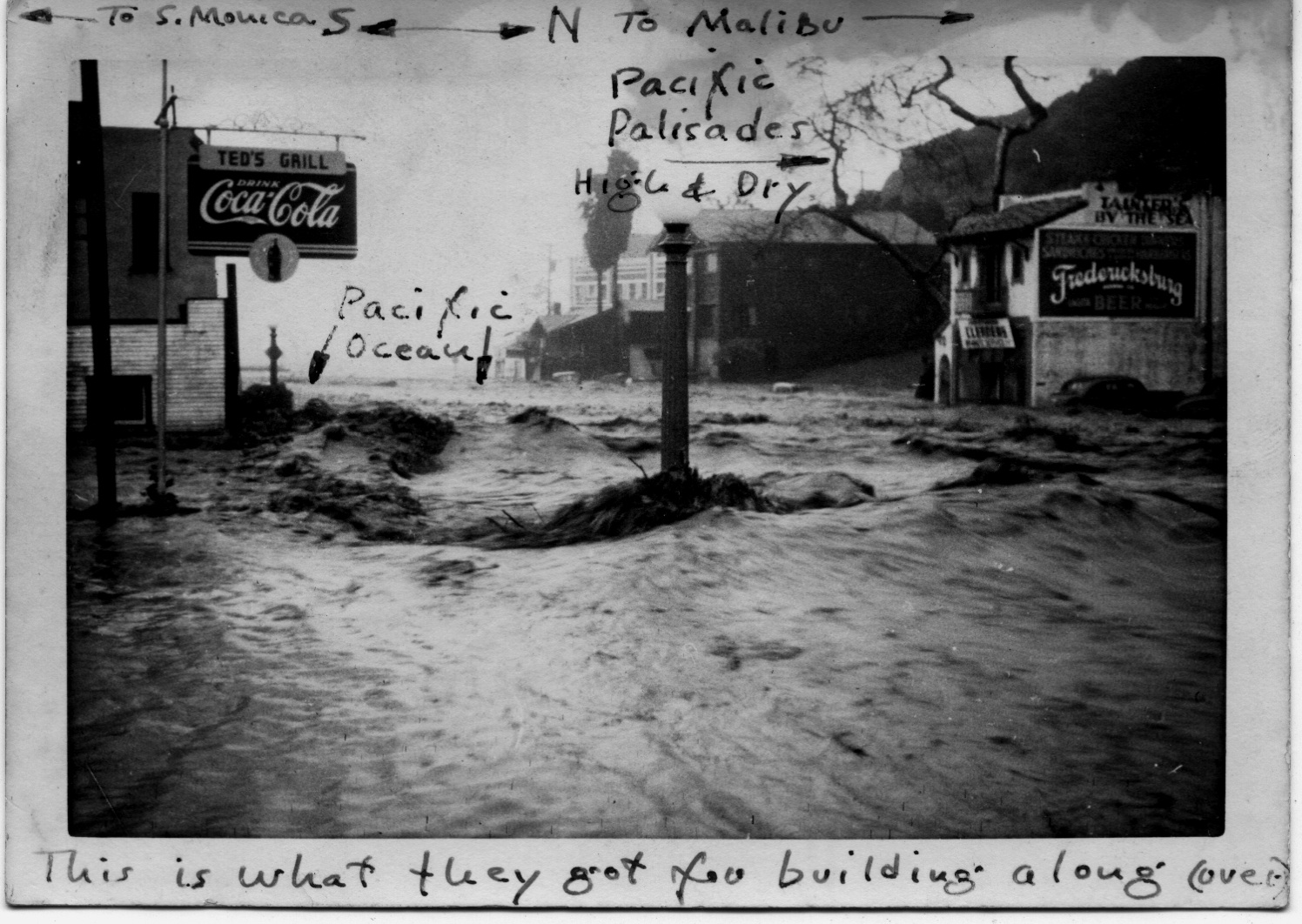
Listening to Simon Joyner and Tyler Wilcox’s recent conversation about Neil Young’s song “After the Gold Rush” for All One Song: A Neil Young Podcast, I recalled that I had written an interpretation of the same song in an unpublished essay exploring the recurrent imagined image of the flooding of Los Angeles in the work of Thomas Pynchon, Brian Wilson, and Young. I wrote the piece in fall 2024 and submitted it to a music-focused literary magazine. A few months later, wildfires swept through Los Angeles and Southern California, causing deaths, thousands of families to be displaced from their homes, and millions of dollars in property damage. It seemed in poor taste to publish my essay at the time, so I withdrew it. But I’m sharing it now. Perhaps it’s still in poor taste, but I hope that the essay can be viewed as an imaginative exercise just as the writers themselves have no desire for wanton destruction of a city. Notably, this piece was written before One Battle After Another, Paul Thomas Anderson’s adaptation of Vineland, which did not include a cinematic version of “The Dream of the Gentle Flood.” Lastly, Brian Wilson passed away after I wrote this essay. Long may he run.
————————————————————————————-
Los Angeles has been destroyed many times in movies and books, whether as the result of fires, earthquakes, landslides, volcanos, or sliding into the ocean. Mike Davis catalogued true and untrue stories of LA’s demise in his 1998 book Ecology of Fear: Los Angeles and the Imagination of Disaster, calling Los Angeles disaster fantasies created by Hollywood and fiction writers a “dark rapture.”
The novelist and one-time Southern California resident Thomas Pynchon participated in this shared artistic horrific nightmare most memorably and lyrically in his 1990 novel Vineland. The devastation of LA comes in the form of a tidal wave and subsequent flooding of the city. This story is related in the form of a dream by a character named Frenesi, seemingly out of nowhere in Pynchon’s typically discursive style, with the writer even naming the passage, “The Dream of the Gentle Flood” as if it was a stand-alone short story:
“A California beach town, the houses tightly crowded, nearly all of glass, huge windows that were really glass walls, all trembling at the wind off the ocean, would be partly engulfed by a tidal wave, long announced, daylit transparent green, flowing smoothly in, with plenty of time for people to get to higher ground, bringing the sea in up the hillside exactly to the level of the house Frenesi was in, observing. Though everyone in town was safe, the beaches were gone, and the lifeguard towers and the Piers, all covered by the cool green Flood, which almost paralyzed her with its beauty, its clarity…for ‘days’ she could watch nothing else, while around her the town adjusted to its new shoreline and life went on. Late at ‘night’ she went out on her deck and stood just above the surf, looking toward a horizon she couldn’t see, as if into a wind that might really be her own passage, destination unknown, and heard a voice, singing across the Flood, this wonderful song, the kind you heard stoned over at some stranger’s place one night and never found again, telling of the divers, who would come, not now but soon, and descend into the Flood and bring back up for ‘whatever has been taken,’ the voice promised, ‘whatever has been lost…’”
Though Pynchon participates in the collective hallucination about LA’s apocalypse, it’s with a wistful, longing tone, as opposed to the darkly gleeful spirit found in so many of the examples cited by Davis in Ecology of Fear. Frenesi’s dream is suffused with regret and a yearning for escape by wind beyond an unseen horizon. But what is this song that Pynchon writes of, the one that is heard once, but is “never found again”? It’s about divers who dare to enter into the new surf-line to recover “whatever has been taken” and “whatever has been lost.” The name of the song is not named by Pynchon.
This excerpt from Vineland is a beautiful piece of writing by an author who usually utilizes music in his fiction as a vehicle for comedy. Pynchon routinely inserts pun-laden lyrics of made-up songs into his books, usually acting as one more digression from the central narrative. In the case of the song alluded to in “The Dream of the Gentle Flood,” Pynchon leaves it to the reader’s imagination, beyond the two lyrical snippets that seep with possibility. The song that most fits the tone and certainly the content of this passage from Vineland is “Surf’s Up” by The Beach Boys.
Originally recorded during the 1966 sessions for the unfinished Smile project, “Surf’s Up” is the culminating vision of Brian Wilson’s songwriting in the 1960s. Co-written with Van Dyke Parks, the lyrics are riddled with a kaleidoscopic blend of images, while also name-checking Edgar Allen Poe and Guy de Maupassant stories. Parks’ words seem to be an indictment of a decadent society that leads to the disillusionment of the narrator. The references to the nursery rhyme “Brother John” and the New Year’s Eve standard “Auld Lang Syne” hint at a yearning for childhood. This longing is especially emphasized by the gorgeous melody that flows through and seesaws around the undulating and continually shifting chord progression. This melody is laced with a delicate balance of both melancholy and joy that are unmistakable due to Wilson’s unique singing style. He has the ability to make the listener laugh and cry, even when singing about a surfer girl, the warmth of the sun, or “A blind class aristocracy.”
All of this builds to the lyrical climax of the song: Wilson’s declaration of the title: “Surf’s up.” It’s an evocative phrase in many ways. It refers to a turbulent day at the beach in which the waves are large and, well, particularly good for surfing. Thus, the title works as an allusion to The Beach Boys’ early hits: “Surfin’,” “Surfin’ Safari,” “Surfin’ USA,” “Catch A Wave,” and “Surfer Girl.” This unimpeachable catalog established a 1960s Southern California teenage utopia, evoking sunshine, cars, love, rock and roll, and surfing for national audiences. The band was a phenomenon, hitting in a sweet spot between the first wave of rock and roll and the British Invasion. Imagine a midwestern teenager hearing “Surfin’ Safari” on the radio for the first time in 1962—it must have been an immediately arresting and alien sound as if the song’s origin was not Los Angeles but rather Venus. By the time of the recording “Surf’s Up” in 1966, The Beach Boys had left the surfing references behind in their music, so the surf allusion was a callback to the innocence of youth, not only for the band, but for their audience.
After Wilson sings the title, he then hums a few notes as if no words could possibly fit after this acknowledgement. Wilson soon resumes singing lyrics, finishing the final verse of “Surf’s Up”:
Surf’s up
Aboard a tidal wave
Come about hard and join
The young and often spring you gave
I heard the word
Wonderful thing
A children’s song.
The rise of the surf causes a tidal wave, forcing the song’s narrator to change course and regain a childlike wonder of the world. In the Smile Sessions version of “Surf’s Up” linked above, the song then transitions to a coda featuring classic, heavenly Beach Boys overlapping vocals and harmonies. The lyrics resume the “Child is the father of the man” theme from a previous song on the album.
During the time of the same 1966 recording sessions, Wilson performed “Surf’s Up” by himself, accompanied only by a piano. It does not feature the coda, but instead ends with Wilson simply singing wordlessly over the final chords:
The ending of this version, after the surf has risen and a tidal wave has wiped everything away, Wilson’s regretful, wistful, and divine vocals seem to express Frenesi’s sentiments within “The Dream of the Gentle Flood”: “Whatever has been taken…whatever has been lost.” Those are the lost words from a lost song that Wilson doesn’t sing, but by all rights should be singing.
These versions of “Surf’s Up” were largely unheard by the public until the song was re-recorded and released on the 1971 album Surf’s Up, perhaps as a mea culpa by the rest of The Beach Boys to Wilson. In between the writing and initial recordings of the song and the later release, there was another project that also centered on a tidal wave destroying Los Angeles.
After the success of the 1969 film Easy Rider, studios were looking to take advantage of the so-called counterculture and were buying up scripts that might appeal to the youth market. Anything hippie-related might sell! Within this environment, the actor Dean Stockwell was encouraged to write his own screenplay. His resulting story centered on the artistic community in Topanga Canyon, located in the mountains outside of Los Angeles where Stockwell lived. The screenplay has since been lost, but Shannon Forbes, a friend of Stockwell’s, recalled details of the project:
“It was sort of an end-of-the-world movie…..At the very end, the hero is standing in the Corral parking lot [in Topanga] watching this huge wave come in and this house is surfing along, and as the house comes at him, he turns the knob—and that’s the end of the movie.”
“It’s not a linear, regular storytelling kind of film…Really what was in my mind was that the gold rush in effect created California. And the film took place on the day California was supposed to go into the ocean. So that’s what happened after the gold rush.”
Neil Young was also living in Topanga at the time and was friendly with Stockwell. In a 1995 interview, Young shared his memories of the screenplay: “It was all about the day of the great earthquake in Topanga Canyon when a great wave of water flooded the place.” Young provided more details in his 2012 memoir Waging Heavy Peace:
“When I returned to Topanga, Dean Stockwell came by the house with a screenplay called After the Gold Rush. He had co-written it with Herb Bermann and wanted to know if I could do the music for it. I read the screenplay and kept it around for a while. I was writing a lot of songs at the time, and some of them seemed like they would fit right in with this story. The song ‘After the Gold Rush’ was written to go along with the story’s main character as he carried the tree of life through Topanga Canyon to the ocean.”
“After the Gold Rush” is a time travel song in which the song’s narrator experiences the phases of time simultaneously. He dreams about a past with “knights in armor” and “peasants singing.” In the next verse, the narrator is fully in the present, lying in squalor, wishing he was stoned, contemplating the possible betrayal of a friend. The final verse brings the narrator into the future among the “silver spaceships” and the “chosen ones” bequeathed with colors, who will deliver the promise of Earth to another planet since humans have recklessly destroyed Mother Nature at home.
In the second verse of the song set in the present, Young envisions the end of the world:
I was lyin’ in a burned-out basement
With a full moon in my eyes
I was hopin’ for replacement
When the sun burst through the sky.
The full moon and the sun meeting in the sky at once feels like the destruction of an American city that could be straight out of Ecology of Fear. Yet it doesn’t depict the tidal wave that Stockwell imagines wiping out Topanga and all of Los Angeles.
Stockwell’s screenplay was never made into a movie. He met with executives at Universal, who must have gotten cold feet thinking about having to make a movie with Topanga art freaks like Stockwell and Young. Young went on to make “After the Gold Rush” the title track of his 1970 album, but only two of the songs on the record were connected to the soundtrack; the title cut and “Cripple Creek Ferry.” No other songs that Young wrote for Stockwell’s soundtrack have emerged.
Without being able to read Stockwell’s screenplay or know the other songs that Young wrote or could have written for the project, it’s reasonable to contemplate the song “Surf’s Up” playing during an imagined screening of the movie After the Goldrush. The tidal wave that Parks/Wilson envisions with their song becomes reality in Stockwell’s screenplay. One more bit of conjecture: perhaps “Surf’s Up” itself was the inspiration for the movie After the Goldrush. The themes and timing both line up to make it a possibility.
Regardless of this bit of imaginative speculation, the songs “Surf’s Up” and “After the Goldrush” are aligned in many ways. Young’s first verse conjures up images straight out of a Renaissance Faire that fit with the figures and language in the “blind class aristocracy” verse of “Surf’s Up.” Additionally, both songs hint at a foresight of a coming disaster, doom on the horizon, but also have an innocent, utopian belief that humanity can be saved. In “Surf’s Up,” Wilson sings of a “children’s song,” while “After the Goldrush” has children crying as the chosen ones carry the tree of life aboard a spacecraft for a possible future in the stars. Beyond lyrical connections, there are similarities between the two performances as Wilson and Young’s both convey a fragile innocence in the way they sing. On a superficial level, “Surf’s Up” and “After the Gold Rush” are both piano-based and the flugelhorn solo on the latter is analogous to the French horn ensemble on the original 1966 take of the former.
Ultimately, it doesn’t matter if Neil Young knew the song “Surf’s Up” when composing and recording “After the Gold Rush.” Furthermore, Thomas Pynchon would never say if he had either song in mind when writing about the “The Dream of the Gentle Flood” passage in Vineland. Regardless, both songs and Pynchon’s piece are saturated with the same emotions — regret, longing, and eventually anguish — that connect to a common theme of lost innocence.
The last word in all of this — especially one that doesn’t involve destruction and death — is Young’s 1976 song “Long May You Run,” an ode to his beloved 1948 Buick Roadmaster hearse which he named “Mort.” Mort was Young’s first real car, the setting and vehicle for many of his teenage adventures, which eventually self-destructed when Young was 17 years old. “Long May You Run” contains Young’s fantasy about the ideal end for his favorite car:
Maybe The Beach Boys have got you now
With those waves singing “Caroline”
Rolling down that empty ocean road
Getting to the surf on time.
The utopian vision of “Long May You Run” is as much of a reverie as Pynchon’s dream cataclysm in Vineland, but it has a happy and satisfying ending. Everything has been reset. The surf has receded to its rightful place. Whatever has been lost — in this case Young’s symbol for his lost youth — has not so much been restored, but rather found a rightful resting place alongside The Beach Boys.
Photo: Chris English, CC BY-SA 3.0 via Wikimedia Commons.


.jpg)
Utterly wonderful essay, thanks!
LikeLiked by 1 person
Thank you!
LikeLike
Meant to say I love Vineland.
LikeLiked by 1 person