Director Robert Altman called his 1973 adaptation of Raymond Chandler’s hard-boiled crime novel The Long Goodbye “a satire in melancholy.” The film stars goofily sincere Elliott Gould as detective Philp Marlowe alongside the beautiful Nina van Pallandt, baseball pitcher turned controversial memoirist Jim Bouton, film director Mark Rydell, the stormy Sterling Hayden, and Altman regular Henry Gibson.
Keeping the focus on Marlowe but shifting the time period to contemporary Los Angeles of the 1970s allows Altman to depict a sketch of the people and mores of this setting. In addition to changing the context of The Long Goodbye, Alman also alters the tone of the story, moving away from Chandler’s tough, hard-edge manner and instead adopting a looser, jazzier, stoner vibe to Marlowe and his adventures. Altman’s movie version of The Long Goodbye has the feel of an Elmore Leonard novel rather than Chandler’s writing. The following piece will dive into the movie The Long Goodbye by exploring Gould’s portrayal of Marlowe, the film’s physical environment, and the soundtrack.
“It’s Okay with Me”
Much of the immediate critical and audience response to the film’s release in 1973 objected to the slovenly nature of Gould’s interpretation of Marlowe as opposed to the sharpness of Humphrey Bogart’s Marlowe as seen in 1946’s The Big Sleep. Though Marlowe’s apartment building is gorgeous on the outside with its view and unforgettable elevator feature, his actual apartment is a dump on the inside with match strike marks dotting every wall. The film opens with Gould bumbling around in the middle of the night attempting to find and purchase “Courry brand cat food,” the only thing that his cat will eat. Though this cat food/shaggy dog sequence seems out of character for Chandler’s Marlowe, in the opening of the 1940 novel Farewell, My Lovely, Marlowe takes a case on spec without any promise of a fee because he has no other clients or anything else going on in his life. He’s bored. This sounds like Gould’s Marlowe on any other day of his life.
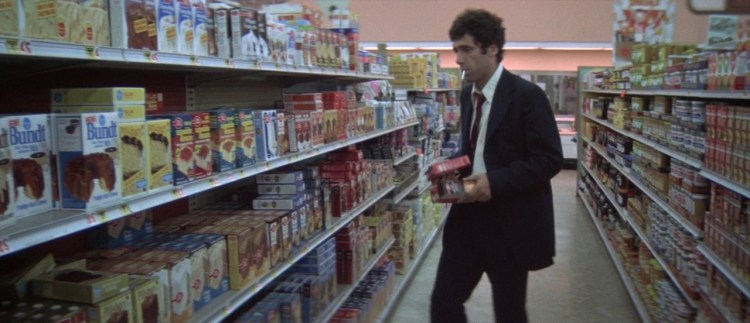
Marlowe in the film version of The Long Goodbye is mostly a doormat. He buys brownie mix for the hippie neighbors next door with a shrug of acceptance and has no real objection or hard questions when his friend Terry Lennox shows up in the middle of the night asking him to take him to Tijuana despite the bruises on his knuckles. The permissiveness of this Marlowe is highlighted by his repeated refrain, “It’s okay with me.” This line is a true reflection of the anything goes, I-don’t-want-to-harsh-anyone’s-vibe nature of 1970s’ LA. You can do whatever you want, according to Gould’s Marlowe, all the time. That is until he finally puts the pieces together over the course of Altman’s unhurried plot to discover that his friend Lennox lied to him and ultimately calls Marlowe a loser. Despite his sloppy, untidy, disheveled nature, Gould’s Marlowe is loyal to a point and this betrayal is the point. Then it’s not okay with him anymore. This seemingly bumbling Marlowe does in fact possess a moral code, perhaps the only one in this code-less LA milieu.
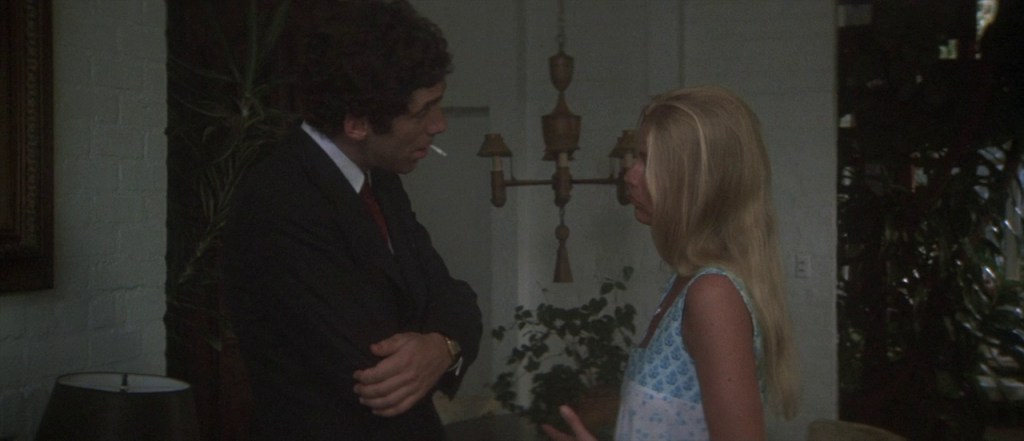
Gould’s Marlowe is certainly handsome and could easily sleep with any of the women he meets throughout the film, but there’s a gentlemanly restraint to him. He never lusts after his naked hippie female neighbors, even though every man who visits his apartment gawks at them with googly eyes. Gould never bats an eye. While there’s an obvious connection between him and his stunningly beautiful client Eileen Wade, Marlowe never acts on it. While the book version of Marlowe kisses his client and lusts after her, Gould’s Marlowe would never do such a thing, yet another example of his below-the-surface code. He doesn’t even call her by her first name and instead refers to her as “Mrs. Wade” throughout the movie.
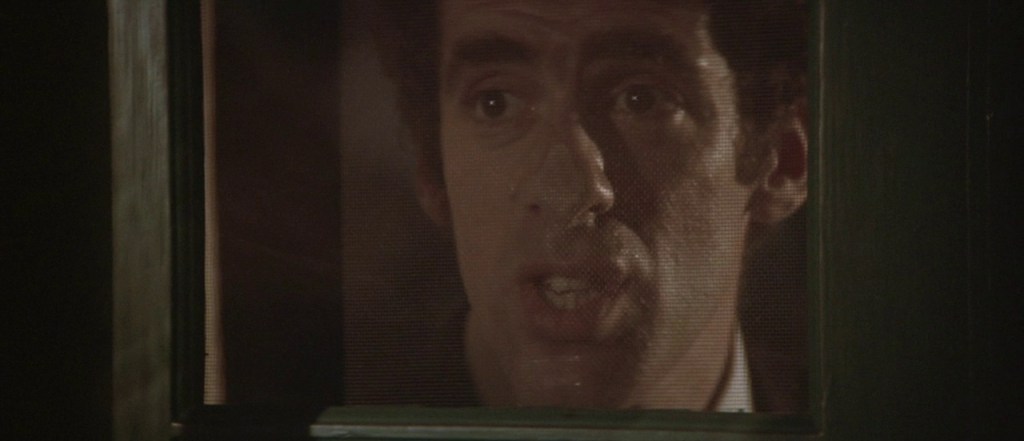
Altman’s satire doesn’t work without Gould magnificent comic sensibility. He’s great at delivering one-liners, but also creates non-verbal comic moments. Taking a small bite of dried apricot offered to him by the healthy conscious, living-on-the-beach-in-Malibu Mrs. Wade, Marlowe is horrified by its taste, makes a face, and tucks it into his breast pocket, all without breaking the steady yammering of his verbal flow. Gould is perfect in his delivery of the line, “Is this where I’m supposed to say, ‘What’s all this about?’ and you say, ‘Shut up! I ask the questions ‘round here’?” He also turns down Mrs. Wade’s offer of wine and says that he’ll just have a beer in the wineglass. Speaking of drinking, the ease with which Gould orders a CC & ginger is as effortless as saying “hello.” And there’s nothing better than Gould lighting up a cigarette in a hospital and speaking to the nurse in between puffs, all while trying to put his clothes back on.
Gould’s magnetic performance is easily seen in the scene in which he first speaks with Mrs. Wade on the phone. This Marlowe doesn’t have his own office, but instead receives his business calls at his favorite bar, of course. The scene features a long continuous take with the camera slowly zooming in on Gould smoking a cigarette while talking into the phone handset with the audience only hearing his side of the conversation. Even though the scene barely moves the plot along, Gould is so compelling. He is the perfect Marlowe for Altman’s presentation of Los Angeles at this particular moment in time. It’s as much Gould’s movie as it is Altman’s.
Scuzzy ‘70s
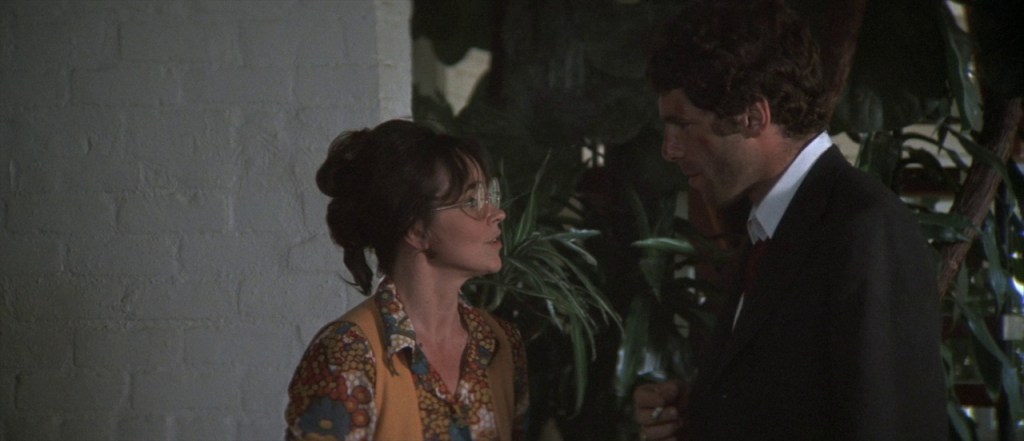
The Long Goodbye belongs to a grouping of films that contain a certain look and feel that should be classified as the “Scuzzy ‘70s.” Other movies that fall into this category include Altman’s California Split (1974), A Woman Under the Influence (1974) and The Killing of a Chinese Bookie (1976), both directed by John Cassavetes, and Cutter’s Way, which was released in 1981 but spiritually belongs with the others. Most of these movies are set in Los Angeles or California and though some scenes feature that warm California light, most eschew it in favor of the dark interior of a bar, a casino, a nightclub, a police station, and the like. Though there’s air conditioning, the characters always seem to have a film of sweat on their skin as if fending off the leaded gas fumes from the giant 1970s sedans driving outside. For younger movie nerds, the first viewing of Scuzzy ‘70s movies happened on VHS tapes with bad transfers from the original film. All of the VHS versions of Scuzzy ‘70s movies have the look of worn, faded photos of ‘70s-era photo albums.
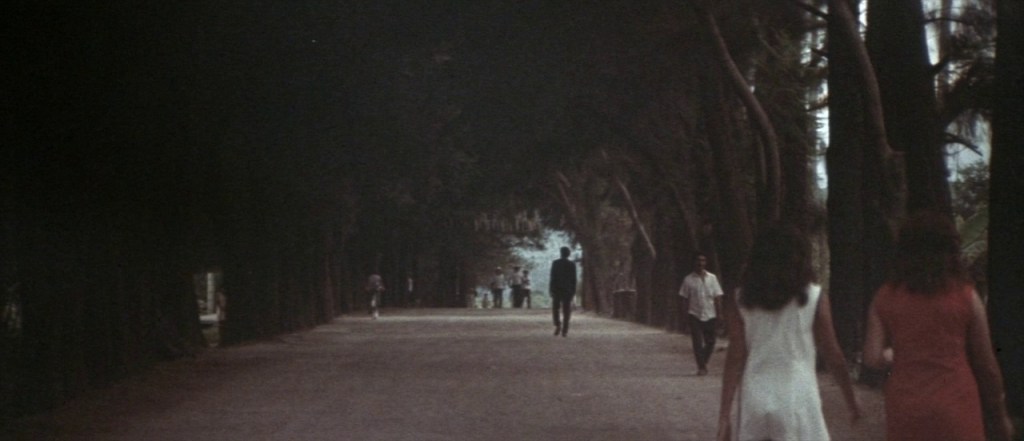
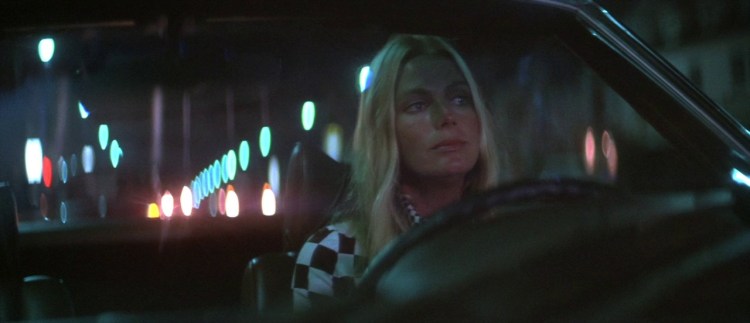
Obviously, The Long Goodbye features plenty of scenes with natural light, especially those at Mrs. Wade’s house on the beach (filmed at Altman’s own Malibu house). But the film has a fuzzy look to it as Altman and cinematographer Vilmos Zsigmond gave it “a soft pastel look reminiscent of postcards from the 1940s” as compensation for the Southern California light, according to David Thompson’s Altman on Altman. This hazy, indistinct photography only contributes to the worn feeling of the film.
The decor is another important element of Scuzzy ‘70s films. For example, in The Long Goodbye, when Marlowe receives his messages at the bar/office, he sits down next to the piano player trying to learn a tune (played by recognizable “that guy” character actor Jack Riley), who is sitting under an artwork depicting a clipper ship:
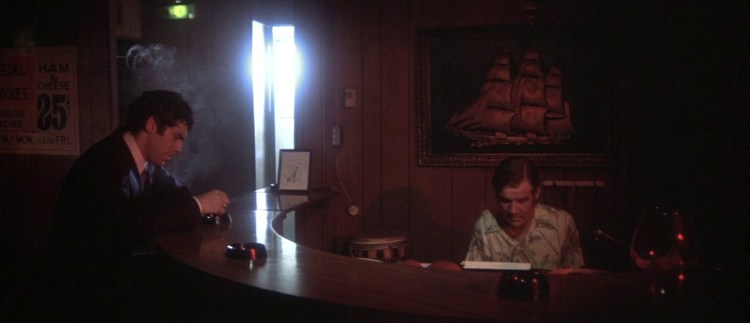
It doesn’t appear to be a painting but rather an engraving as it reflects a dull, metallic sheen. What is this thing? The rest of the bar doesn’t have a nautical theme to it and the establishment doesn’t seem to be located near the ocean. This is the type of artwork that would most certainly hang in a house, a dentist waiting room, or an insurance office and immediately give off vibes of 1970s’ furnishings.
It’s fun to see filmmakers who grew up in that time period who are able to accurately capture the Scuzzy ‘70s look in their own movies after the fact. The best example is Paul Thomas Anderson’s Boogie Nights, which has plenty of scenes beautifully utilizing LA’s natural light, but feels most at home in the interiority of basement porn sets and nighttime cocaine sessions in sprawling San Fernando Valley houses.
The Soundtrack
Two songs are featured in the soundtrack for The Long Goodbye: “Hooray for Hollywood,” which bookends the film, and the original song “The Long Goodbye.” The latter tune was written specifically for the movie by future Hall of Fame Hollywood composer John Williams, who went on to write instantly timeless scores for Star Wars, Superman, Raiders of the Lost Ark, and many more. Lyrics for “The Long Goodbye” were written by another Hollywood legend, Johnny Mercer, known for countless standards, such as “Moon River,” “Autumn Leaves,” “That Old Black Magic,” and even the aforementioned “Hooray for Hollywood.”
Mercer’s words fully actualize the elegiac tone conveyed by Chandler’s title of a long goodbye. The phrases are simple and filled with clichés but carry enough longing to work for Altman’s “satire in melancholy.” It’s the ultimate torch song.
There’s a long goodbye.
And it happens everyday
When some passerby
Invites your eye
To come her way.
Even as she smiles
A quick hello,
You’ve let her go.
You’ve let the moment fly.
Too late you turn your head,
You know you’ve said
The long goodbye.
Can you recognize the pain?
On some other street
Two people meet
As in a dream.
Running for a plane
Through the rain
If the heart is quicker than the eye,
They could be lovers
Until they die.
It’s too late to try
When a missed hello
Becomes the long goodbye.
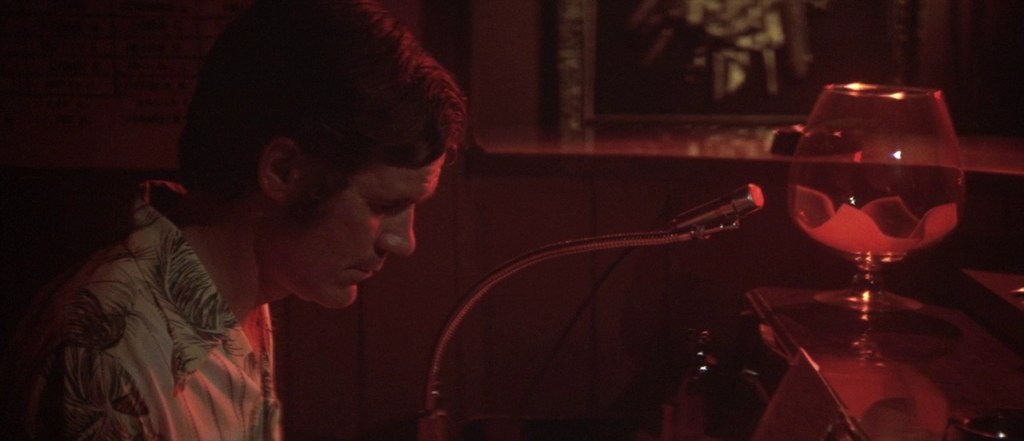
It was Altman’s idea to feature the song “The Long Goodbye” throughout the movie in different genres. Williams coordinated all of the different arrangements in the various styles. There’s a solo piano version performed by John Williams, a bluesy vocal sung by Jack Sheldon, a different vocal rendition by Clydie King (who would later go on to work as Dylan’s singing partner), a ‘70s-era jazz arrangement performed by the Dave Grusin Trio, a second jazzy interpretation by the Dave Grusin Trio, a tango, grocery store muzak when Marlowe is looking for Courry brand cat food, a sitar version for a hippie party, an assortment of Mexican-style arrangements when Marlowe is trying to piece together what happened to Terry Lennox south of the border, a chilling, horror movie score-esque finale that paradoxically transitions well into Marlowe playing the harmonica. And what is the song the piano player is trying to learn that the owner thinks will “beef up the lunch trade” in Marlowe’s bar/office underneath the metallic clipper ship painting? “The Long Goodbye,” of course!
Exquisitely executed by Williams, Altman’s ingenious concept for a movie soundtrack is yet another way to demonstrate Marlowe’s inherent melancholy. It also serves as a splendid texture for the different pockets of Los Angeles (and Mexico) that Marlowe ventures into and the varying characters he meets along the way. In addition to being malleable enough to work for all of the various arrangements, “The Long Goodbye” is beautiful on its own. It deserves to be considered as a standard in the Great American Songbook.
“The Long Goodbye” doesn’t have a long tail of performers tackling it with the frequency of “Stardust,” “Summertime,” or “Somewhere Over the Rainbow.” But let’s imagine a multiverse-style fantasy in which we could decide ideal artists and bands to cover “The Long Goodbye,” regardless of time or place. In this scenario, an artist could perform the song even before its composition by Williams and Mercer. Let’s also utilize Altman’s multi-genre concept for the song so that it can be realized across types of music.
- Ella Fitzgerald – A natural selection. If Fitzgerald could have performed “The Long Goodbye” in her prime, it would have been more widely known and covered by countless other artists.
- Frank Sinatra – Another obvious choice, Sinatra could’ve built an entire concept album out of the tune, similar to In the Wee Small Hours, around the theme of a drawn-out, I-can’t-quit-you love affair.
- Miles Davis – A version of “The Long Goodbye” could have fit into any of the many periods of Davis’s career, but, ideally, this would have been performed by Miles for his 1958 Ascenseur pour l’échafaud soundtrack, à la “Générique.”
- Chet Baker – “The Long Goodbye” would have been a perfect addition to Chet Baker Sings; just envisioning him singing those words and playing that melody brings tears to the eye.
- Bob Dylan – How is “The Long Goodbye” not on Triplicate? In fact, Dylan should be doing it every other night, trading places with Mercer’s “That Old Black Magic” in his setlist.
- Julee Cruise – Imagining her “The Long Goodbye” generates feelings of anger that it didn’t happen. A Cruise/David Lynch/Angelo Badalamenti collaboration on the song would have been the torch song to end all torch songs.
- Tom Waits – Waits could have realized all of the different stylistic arrangements himself, similar to his Night on Earth soundtrack, including solo crooner, mariachi, gypsy, or jazzbo renderings.
- Lana del Rey – Can someone share this post with Lana so that this happens tomorrow? Surely someone can text it to her.
- Elvis Costello – Surprised that this hasn’t already happened as “The Long Goodbye” feels like a sister song to “Almost Blue” (previously covered on Recliner Notes). It could’ve fit well on Kojak Variety or as a B-side to a single from North.
- Jon Hassell – Another trumpet version of “The Long Goodbye”? Yes! With Hassell, it could be something clean as if it was off of 1999’s Fascinoma, but also welcomed would have been an effects-laden rendition with prototypical, Hassellian, multiple harmonic echoes on the melody.
- Friends of Dean Martinez – Bill Elm often tackled instantly recognizable and distinctive melodies with his pedal steel throughout the band’s discography, so “The Long Goodbye” would’ve been a no-brainer.
- Calexico – Their desert noir sound certainly slots their interpretation into the Marlowe-in-Mexico part of this imagined movie soundtrack.
- Bill Frisell – Another “call it in now; this has to happen” selection.
- Lonnie Holley – It feels as though a Holley cover would be an ideal platform for one of his long, improvised monologues, riffing on the themes of both the song and the movie.
- The Walkmen – Hamilton Leithauser certainly possesses the pipes to pull off the melody in any form, but it’d be fascinating to hear the band’s arrangement, whether they’d decide to blow the roof off the place or occupy a more whispery, noir-ish space.
- Cowboy Junkies – Wasn’t there an expanded anniversary edition of The Trinity Session with “The Long Goodbye”? There wasn’t? Huh.
- Chromatics – If Nicolas Winding Refn decides to do a 21st century, ultra-sleek, all-surface, more-melancholy-nightmare-than-satire take on the movie, then Chromatics should do the entire soundtrack.
Alison Krauss, Father John Misty, Robert Wyatt, Mary Halvorson, Cindy Lee, Gillian Welch, Ry Cooder – the list goes on and on, demonstrating the plasticity and timelessness of Williams and Mercer’s composition.
Legacy
Altman and Gould never attempted a sequel to The Long Goodbye, but there have been films since its release that possess similar DNA. While it doesn’t contain as much melancholy, The Big Lebowski definitely carries the satirical LA piece of The Long Goodbye. Paul Thomas Anderson’s Inherent Vice is also set in the early ‘70s with many of the same characteristics as Altman’s film, but as an adaptation of Thomas Pynchon’s novel, its wistfulness is less about loneliness than about the loss of a kind of hippie innocence. Under the Silver Lake would work as an excellent double feature with The Long Goodbye. It too is a Los Angeles mystery, though with many more surreal elements than Altman’s realist sensibility. David Robert Mitchell’s film certainly taps into the same desperate longing for connection and meaning as The Long Goodbye. Two television series that also work as descendants of Altman’s film include Terriers, which is set in San Diego but owns many of the same shaggy dog mystery qualities, as well as last year’s The Lowdown, which is a 21st century Tulsa version of The Long Goodbye. In fact, that may have been the pitch to the network for the show.
The Long Goodbye is a singular work. It had the right director working with the ideal star with an imaginative soundtrack to capture the exact tone of satirical melancholy fitting for a specific location and time period, yet somehow, it’s still timeless. It’s okay with me.