Bands start due to any number of reasons, but it’s rare to hear about one beginning from someone who isn’t in the band. Also uncommon is if the outside instigator is not a parent, a significant other, or some kind of boy band impresario.
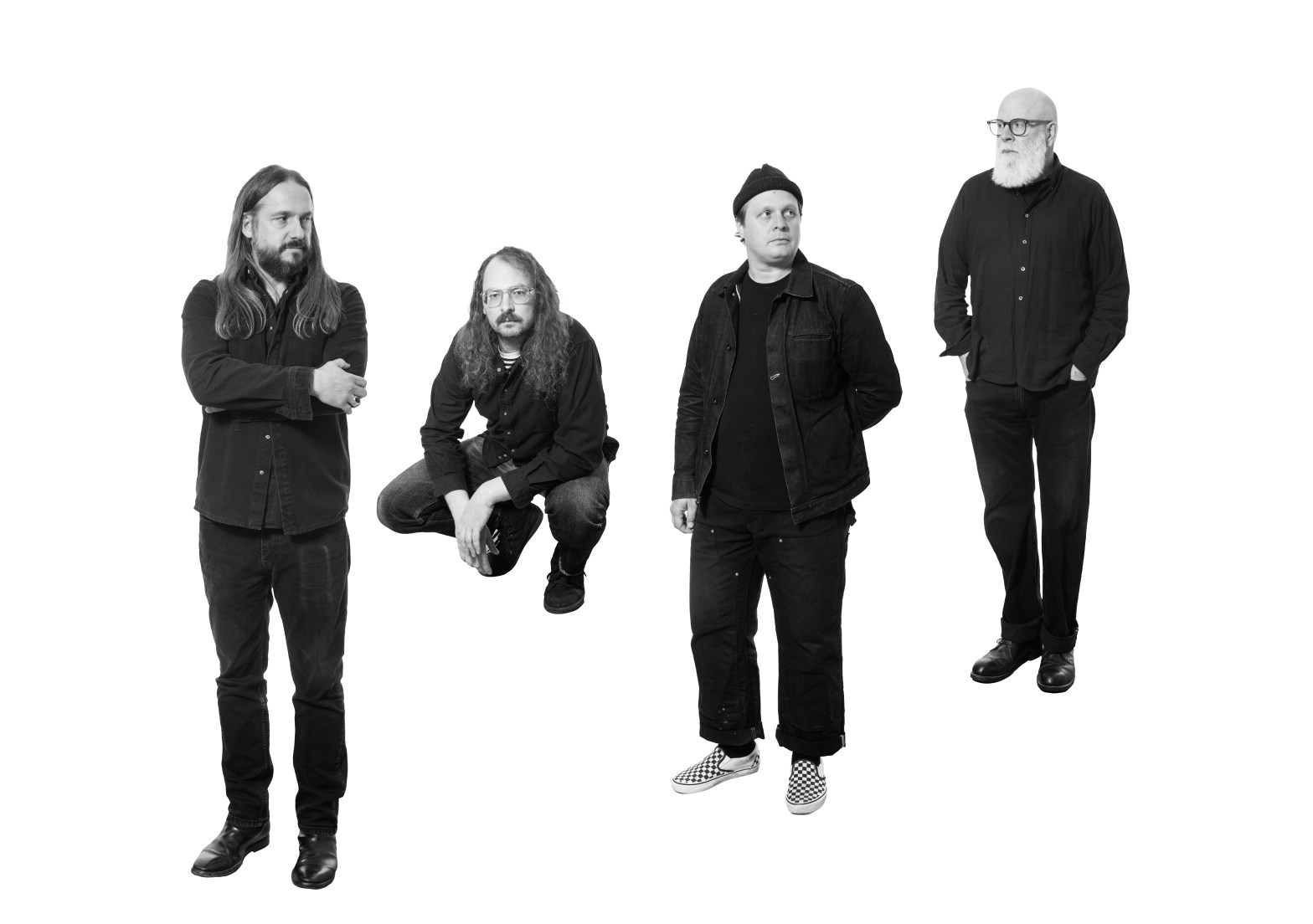
Yr Knives is an exception. This combo’s origins lie with a concept by musician Paul Karner, who imagined a dual lead guitar band with distinct voices, whose parts are separately insignificant but work when played together. Guitarists Andrew Trim (Hanami Quartet, Retroreflecto) and Brian J Sulpizio (Health&Beauty) came together to make Karner’s vision a reality by writing an abundance of twin guitar music. They subsequently invited bassist Douglas McCombs (Tortoise, Eleventh Dream Day, a dozen other bands and projects) and drummer/recording artist Quin Kirchner to fully realize the prophecy.
There have been a number of double lead guitar bands over the years, including The Allman Brothers Band, Stills and Young in Buffalo Springfield and CSNY, Television, Sonic Youth, among many others. Yr Knives encompasses all of these models while concurrently undercutting each one. Begin Yr Singing, the band’s debut album, demonstrates the obvious camaraderie of Trim and Sulpizio, who seemingly handle everything with ease, whether they’re loudly proclaiming proggy riffs (“Stretch Bath”), executing fluent jazzy harmonies (“Trimnopedie,” “These Chords”), or igniting skewed, angular components (“Fear&Trimbling”).
The exclamation point of the record is the final track, “White Gladys,” in which the band creates a musical space similar to Yo La Tengo’s “Let’s Be Still” (a song previously explored on Recliner Notes):
Without any outright guitar solos, the band achieves a slow building, composite swirling sound made up of a slew of complementary and evolving guitar parts, unhurried bass and drums, all of which is buoyed by multiple horns. “White Gladys” conjures the feel of heading into the wide expanse of a middle distance that one can never really arrive at but never stops trying.
To correspond with the release of Begin Yr Singing, Recliner Notes spoke with Sulpizio and Trim. They walk through Karner’s original concept, the band’s origin story, the vital role McCombs and Kirchner had in shaping the songs, Cooper Crain of Bitchin Bajas helping with the mixing of the album, and much more.
Recliner Notes: How did the two of you originally meet?
Andrew Trim: The very first encounters that Brian and I had together were through him engineering other projects of mine. When I moved to Chicago in 2010, I was participating a lot in the improvised jazz scene, a split between straight ahead stuff and more experimental things. Somebody had referred me to Brian because I wanted to do a very short notice recording session. I had a friend named Danny Meyer, who’s a wonderful improviser and saxophone player, who was moving to New York and traveling through, and going to stay with me in Chicago. He had, spur of the moment, contacted me, being like, “Well, I’m going to come through town, and I really want to make a record while we’re there.” And I was like, “Oh, really? That’s two days from now.” I believe it was the saxophone player Caroline Davis who was the one who told me about Brian and that he had this place called the Chateau, which was a recording studio/house that he lived in that was off of Humboldt Park in Chicago. I called him and I said, “Hey, I want to make this record two days from now.” After that, there were many other projects of my own, various bands and stuff. Brian’s probably recorded at least six or seven other records for me over the years.
Recliner Notes: But the two of you hadn’t really played together before Yr Knives, right?
Brian J Sulpizio: I’m a big fan of jazz and jazz-adjacent music. It’s the main thing I go see and the main thing I love to listen to and appreciate and it blows my mind open. In my other project, I’ll find those chords and use them: the harmonic movements or moving one chord to another. Understanding how to place those things in context is something that’s never come to me. So I don’t presume to play with people who I find to be really good at jazz unless I have a specific thing that we’re doing. I might ask somebody to play a chart or to improvise over something. I think the reason we never played together was that it wouldn’t make any sense. It was sort of like, “What will we do together? You’ll play circles around me. That’ll be what happens, and not that interesting to anyone” [laughs].
Recliner Notes: From reading the press kit, Paul Karner had the concept originally for the band. Did he pitch it to both of you or one of you?
Brian: He pitched it to both of us independently. I’d also recorded Paul’s music a long time. He’s done records where he’ll rearrange music that is really meaningful to him. I feel like that’s where he brings a lot of it out. You hear him and what that music means to him in the way that he’s arranging these other parts.
Andrew: Brian engineered a session of Paul’s. The entire session was us playing the music of Mr. Rogers. I played guitar. Brian engineered, and we played arrangements that Paul wrote of Mr. Rogers’ famous songs. [Paul] was asking us to perform on a couple of his songs that he had written. Unlike the previous times in which I had occasionally been the side man guitar player in a recording situation where Brian was engineering, in this particular instance, there was a different engineer and Brian and I were both playing guitar. The act of doing that recording session is what gave us the idea to make that into a band.
Brian: I remember [Paul] sent us these separate parts. I had my part, but I didn’t have Andrew’s part, and I had practiced my part because I’m a slow reader. I was like, “Okay, I need to figure out what this is on my own time, and then go there already knowing what it’s going to be.” I remember playing these things and being like, “This is it? This is what this idea is?” [Laughs] Because it was like two notes. It was intervals, basically. And I was like, “These intervals are so stupid. It sounds so dumb when I play it.” Andrew had the idea that we should practice together before we go there. So, he came down a little early over to my place, and we played them together. And it was like, “Oh, I get it now.” These are four note chords, and they sound beautiful when the two of us play them together, these intervals.
Recliner Notes: So, you guys do this session, and you have a light bulb moment, and say, “We need to do this some more.”
Brian: Exactly. It was like, “Wow, we should try to make music where we do this.”
Recliner Notes: Andrew, I think most of your music is instrumental. Whereas Brian, you’re comfortable writing songs with lyrics and melodies —
Brian: I don’t know that I’m comfortable with it.
Recliner Notes: Sorry, I didn’t mean to put words in your mouth! [Laughs] Was it always going to be an instrumental band?
Andrew: I think that that’s still up in the air. It’s an instrumental band at the moment and might remain an instrumental band. But I think that we both were somewhat flexible even on that. At some point, there could be singing, but there isn’t any yet. That’s partly why the album is called what it’s called, this open-ended idea about this collaboration where a lot of things could potentially happen, and nothing has been completely ruled out yet.
Brian: We’re all getting a sense of what we can do together, what we can contribute to the raw material of the thing, that grist for the mill.
Recliner Notes: When you first were like, “Okay, let’s do this,” were you writing songs together in the same room, or were you writing individual things and bringing them to the other person?
Brian: These are things that we had laying around. I’ll let Andrew speak to his, but, for my part, basically everything that I write, I try to funnel into the Health&Beauty direction. But it might take a long time. If the guitar part came first. I might be waiting years for a melody, and then, even if I have a melody, I might be waiting more years to write lyrics for it. So if those ideas have been sitting around, I was like, “Well, let’s try this.”
Andrew: There were a couple of pieces on this record that were written during the part of time when we were getting together regularly to write. After we had this epiphany about doing this collaboration, we were coming out of the pandemic, and there were a lot of people who were rushing to get back to playing live and trying to make everything go back to the way that it used to be. Both of us felt a little hesitant about that. Instead, we were like, “Well, let’s just get together, the two of us, and we’ll work on writing this music. We won’t rush it, and we’ll work on cultivating something and eventually we’ll see if we can’t put a band together.” And so, I would drive down from Milwaukee to Brian’s house, and we would play guitar, and we’d work on voice memos of different things that I had laying around. Somewhere in there, a couple of new things got written. Brian was in the bathroom, and I came up with something, and he came bursting out of the bathroom, “What’s that?” [Laughs]
Brian: He’s like, “I’m just messing around.” And that one thing turns into [the song] “Double A.”
Andrew: That part of it was funny and amazing simultaneously because I do think that sometimes I have such improviser brain that I don’t always see a composition inside of something I’m fiddling with. Brian is such a great intentional composer. I love his band and have been a huge fan of it for years. It’s great to be in the presence of somebody that you really admire and enjoy their musical energy, and then find out the way that they react to what you’re doing and see something in your own work that’s different. That collaboration, from the very beginning, was so fruitful. It never felt like we were forcing, just having fun and discovering.
Brian: I’ve tried to write with people before and it’s like, “Nothing’s happening here.” With Andrew, it seemed like we were finishing each other’s sentences figuratively and compositionally. We each saw the good next thing from what the other person had presented, and things stay intact but grow as they pass back and forth. It’s really a beautiful thing. His writing with the Hanami Quartet is really strong. There’s a brightness that I feel we’ve generally captured. But we’re also both huge fans of Sonny Sharrock, and that’s coming through, too. The ideas that Andrew brings speak to me, but that I would never do. We’re both coming at it from very different directions, but contributing these things to the other that grow the idea and make it into something that you can’t do on your own.
Recliner Notes: So, you have this material and you bring in Quin and Doug. What attracted you to those two?
Brian: Quin, we’ve both played with in a number of contexts. We played with Ryley Walker a lot together, and he was in Health&Beauty for a year and then he got busy. I did a Health&Beauty session with both Quin and Doug that went really well. I’m not really a jazz player. Andrew and Quin are both really jazz players. They have that language. I feel Doug is heavy and on point and very creatively versed. He’ll invent the thing that is perfect for the thing. [With Doug] I’m not the only non-jazz player in the band.
Andrew: There were a few choices, too, about how we wanted the band to sound. Because when we were first playing through all these songs and it was just the two of us playing guitar together, there’s a lot of different ways to imagine them going. If you imagine a scenario in which somebody’s playing upright bass and the drummer’s using a lot more brushes and little fiddly things, suddenly the band sounds completely different and less unusual and has less forcefulness or power that we wanted to make it sound. We wanted to make it sound big — not that we would necessarily be blowing out speakers or anything — but wanted to make a band with that sort of energy about it. They both fit that approach perfectly.
Recliner Notes: I’m glad that you adhere to the principle of “If Doug McCombs is in the band, provide the space for him to do Doug McCombs things.” What did he bring to the project?
Andrew: He wrote the melody to “These Chords.” For the majority of the bass parts, we were giving him a lot of a lot of runway to do what he wanted to do with them because the band was just coming together for the first time. Now it’s a little more fluid than that. The first time around, Brian and I were doing the legwork, almost as though presenting your resume to some really good musician that you want to be in a band with [laughs]. “Look, we have this entire record of songs ready to go. Will you please join our band?”
Brian: It’s a weird line to toe because we need to present something that makes this music compelling to be like, “Do you want to play with us?” Also, it’s not like, “Here’s what it is and would you like to assume a predefined role?”
Recliner Notes: “White Gladys” is my favorite track on the album. There’s not much soloing from either of you. It’s mostly about entering into a zone and staying there. Is that one of the songs that you two wrote initially, or did you come up with it later?
Brian: That was an initial one. I feel like neither one of us is very active because I feel that track became about Quin making that rhythmic shift. That’s where it took its energy, that looping sort of figure. I think of that as meditative. It’s the kind of thing where if you really want to engage with it you should probably just listen to it for a full day. Decorating it felt really dangerous to me. It’s the four of us playing live. You have Andrew on both left and right [channels]. It’s the one song in the record where I’m in the middle. I got stuck mixing this record, and Cooper Crain really blew [the song] back open. One of his ideas was taking my guitar, which is playing the insisted figure that never goes away, and he made it so that it wiggles from left to right. It’s duplicated and then delayed and panned in a way where it moves a little bit, it shifts. Then you’ve got Andrew’s live track on one side and Andrew’s overdub on the other side.
Andrew: What the piece was asking for was not for improvising so much as other figures, but then also, in some ways, be very repetitive. In the one guitar part that I play, which is what I played when we recorded it live, I’m approaching it in this way that is somehow connected simultaneously to my love of certain krautrock music like Neu!, but then also I’m thinking about a lot of my favorite African guitar music and how there’s these figures that repeat over and over again, and they feel like they have momentum, but they don’t change. They don’t have that arc of energy shift that happens in a lot of music where it goes until it peaks. It’s not really like that. It’s more like you grab energy and it keeps moving forward. It’s more about the momentum than anything else.
Once we got done recording the basic thing, and we were thinking about the piece itself, it sounded like it needed a lot more sonic body. A lot of what I’m doing with the other guitar [overdubs] is adding texture that stays in the same place the whole time. Then the other stuff that’s [on the track] is the horns. We didn’t necessarily want it to be, “Suddenly there’s horns,” but more like the feeling and the energy of horns that could blend in.
Brian: There’s also your stretched-out overdub thing that bridges the gap between the horns and the band.
Andrew: Yeah, it’s giving a landing place for everything to be inside of.
Recliner Notes: Brian – you said that you got stuck mixing the album. Can you share a bit more about what you mean?
Brian: I’ve got my dirty little fingers in a bunch of different pies [laughs]. At some point when I was younger and making music, I was like, “I’m going to do this forever.” It makes sense for me to invest as much as possible in knowing how to do as much as possible so that I can do this, even if nobody else wants me to. I was like, “I’m going to learn how to record myself, and I’m going to acquire a few pieces of things that let me.” I’m glad I did that, but also it’s easy to get stuck. You find yourself without an opinion, at some point. I’ve participated in writing [the Yr Knives songs]. I live tracked it. Thankfully, Nick Broste was there to help us record it, which he did a great job with. Then it was my task to mix it. We’ve gone through this whole process of editing the music and adding more music to the picture, and, at some point, I’m like, “I don’t know what this needs to sound like. I don’t know how to create the illusion of this music happening between two speakers.” Everyone was complaining that it sounded pinched and small and in the center. And I’m like, “Yeah, you’re right.” So, I decided to ask Cooper Crain if he’d help me. And he did, and immediately opened it up, saw some of the things that were possible with it, and made them happen.
Andrew: The way I remember it was that we put a lot on Brian asking him to mix the whole record. He was doing a great job, but there were some moments where he got his head up against the wall about certain things, and I do remember being a part of the encouragement team for reaching out to Cooper.
Brian: I think it was my idea to reach out to Cooper [laughter].
Andrew: Maybe I talked Brian into it. “You should definitely do that.” Sometimes you really need a different set of ears, somebody who’s not emotionally intertwined with the writing process or the performances or the sound of the record to be able to bring a different objectivity to the proceedings. Of course, we’ve known Cooper for a long time and love the things he’s done, both as a musician and as an engineer.
Recliner Notes: Health&Beauty has a song called “Yr Wives,” and this band is called Yr Knives. Is there any correlation between the two?
Brian: Nailed it! [Laughter]
Andrew: I didn’t know if anybody would ever catch that.
Recliner Notes: Yes, I win!
Brian: I can’t believe you just said that to us unprompted. That’s amazing.
Andrew: Somebody out there cares. We were looking for a band name for quite a while. I do a lot of cooking at my house, and I was going through this period where I was getting interested in Japanese knives. I collected a few and I use them in the kitchen all the time. So, I made this joke that I’m a big fan of “Your Wives,” and that it would be funny if we called our band Yr Knives because then it would allow us to have a promo sticker on our album, and it would say “From the artist that brought you the hit single ‘Yr Wives’” [laughter].
Brian: I don’t think we ended up doing that.
Andrew: We didn’t do that on the sticker, but we did name our band Yr Knives [laughs]. I also like the fact that there’s not really a strong meaning to the band name, and there doesn’t need to be really other than that it’s funny to us. I did tell Brian at one point that there’s an element of the band name where I feel like people can take ownership of being a fan of the band because you know they could consider us “their knives” [laughs].
Brian: And we’re here for it. We’re here to be the knives that you need [laughter].
Recliner Notes: I know that Paul Karner did the string arrangement for the song “Fear&Trimbling.” How was it to be like, “Hey, look, you started this.” Is he the band’s biggest fan?
Andrew: He’s a big fan of the band. It should be said that Paul and I have been friends with each other since junior high school, so he’s a really old friend of mine. When I moved to Chicago, he was one of the first people that I reconnected with after being sort of long distance friends when we were much younger. We reconnected, and we played in a cover band together that covered the music of Meat Loaf and have been very close in a variety of different ways since we first started playing in bands when we were 12-13 years old.
Recliner Notes: It’s a nice full circle moment to have him do the string arrangement on the album.
Andrew: We have intentions of including him in some manner again [on the next album] as well. I don’t know in what capacity exactly. There was some conversation about some creative directions for a certain piece that we could get him involved in.
Brian: If Paul wrote something, we could play it. It’s just a thing where Paul needs to do something on every Yr Knives record because he started the band [laughter].
This conversation has been edited and condensed.
Photo by Nathan Keay.

