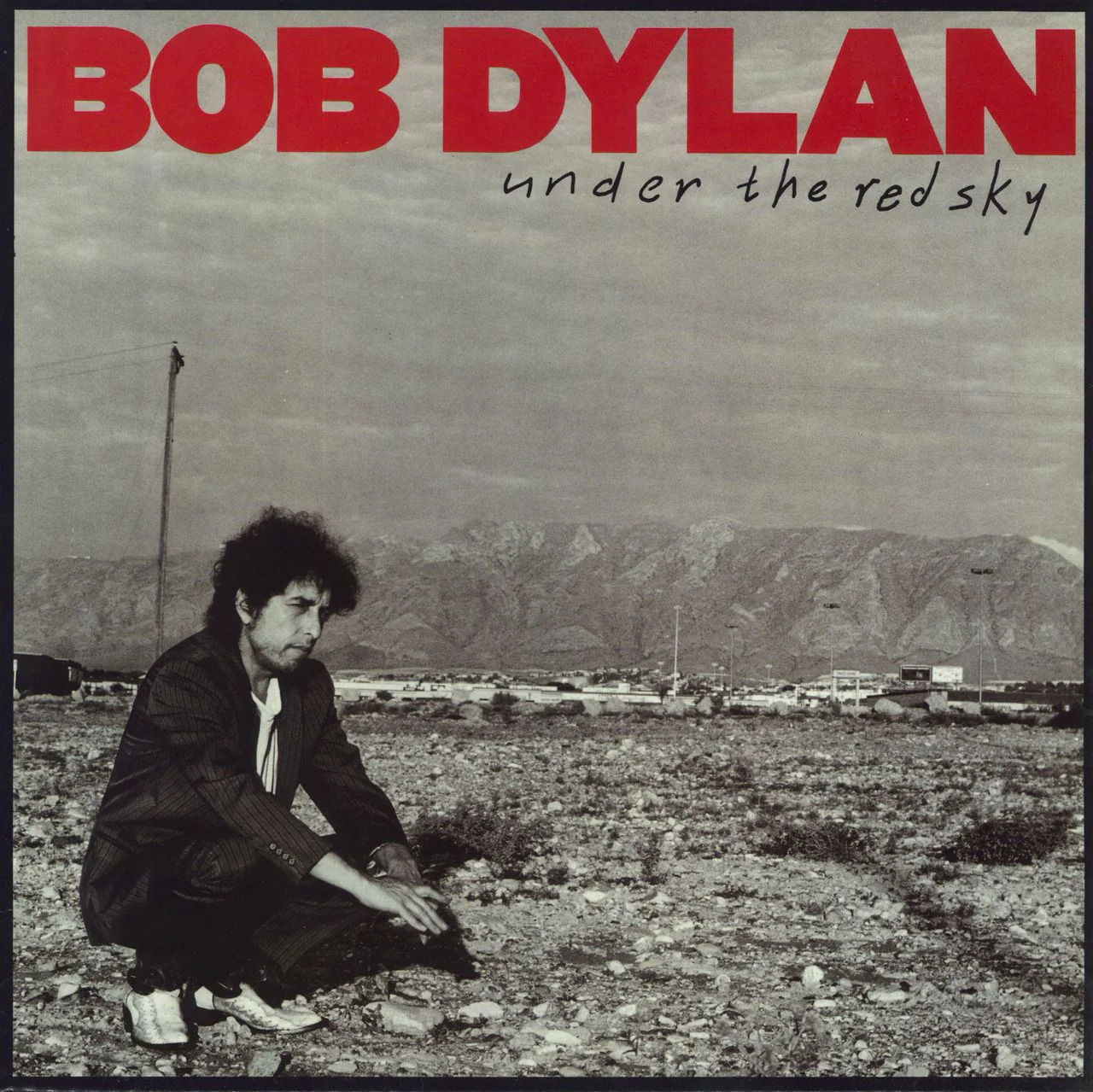
Let’s pretend that the cover of Bob Dylan’s 1990 album Under the Red Sky doesn’t depict one of the most recognizable musicians of the last 50 years. What is being presented in this black and white photograph?
The setting is the Mojave Desert, probably near Palm Springs. But it has the feel of any of the desert country in the American West, anywhere from Albuquerque to St. George, Utah. In the foreground and off-center, there’s a man squatting in what appears to be a dry lakebed. There appears to be a racetrack in the mid-background alongside trailers or possibly a storage unit facility with a mountain range in the far background, cutting the image in half horizontally.
There’s a utility pole sticking out of the man’s back as if he is directly plugged into the electric power grid or the telephone exchange and capable of receiving calls. He has his right hand over his left, covering something up, maybe a cigarette or even a joint. Either way, it’s a closed-off gesture.
From his clothes, it’s apparent he has a little money. It’s a nice suit, pin-striped jacket, and pants, though he doesn’t wear a dress shirt underneath. Instead, he has a t-shirt that’s bunched up as a result of his squatting posture. At first glance, it’s easy to mistake the t-shirt for a flowy, loosely-tied white scarf, but, no, he’s sporting the classic middle-aged guy, t-shirt-with-suit look.
All right, it’s time to talk about those shoes! They seem to be made out of a reptile of some sort, perhaps snakeskin or alligator. A friend told me that alligator shoes usually have a raised look, similar to little tiles, and these look smooth, leading to a guess that they’re snakeskin. In this dry lakebed in the desert, he’s a long way from alligators and snakes could be right outside the frame of the photograph. The shoes have returned to their natural habitat. Regardless of the material, wearing them is a bold choice. Not only does this guy have the cash to buy outlandish shoes, but he’s also not afraid to wear them.
He’s not exactly smiling through his scraggly half-beard, and there’s a slight squint to his eyes. He has a mischievous, nonchalant air. The act of taking the photo itself could be a distraction from too many hours on the road. The road itself may only be a few feet away. “Come on,” he says at the end of a smoke and stretch break, “Take a picture of me in my shoes on these rocks. It’ll be fun.” The last bit is added with enough straight-faced irony to make sure that photo is snapped.
The man in the photo seems to be involved in the entertainment industry or knows his way around a casino. It’s a different flavor from Sydney, the Philip Baker Hall character in Paul Thomas Anderson’s first full-length Hard Eight. He doesn’t have the same compassionate, sad eyes as Sydney, who will tell you how to make a few months’ worth of money off a casino resulting from too many years of mediocre food, bad lighting, and witnessing too many hard-luck stories.
The man in the photograph might reach that benevolence someday, but, at this point, he’s more of a rascal, apparent from the sardonic wrinkle in his eye. Invoking Townes Van Zandt’s tale of two road dogs “Pancho and Lefty,” this guy has built up enough defenses to wear his “skin like iron” and sports breath that has the whiff of kerosene. He might have set off on the road to keep him “free and clean,” but he hasn’t won anything, despite his visible financial success.
Dropping the pretense of not knowing this is Bob Dylan, what is Dylan communicating by choosing this particular photograph to represent him on the cover of his latest album in 1990? First of all, there’s an apocalyptic touch to the album’s title, which is supported by the graphic design. His name is soaked in a bleeding red, accentuated by the black and white of the photograph. Bob Dylan is the red sky in this image.
This cover is a fair representation of Dylan in 1990, namely that he is in full road-dog mode. The relentless touring schedule of Dylan’s Never Ending Tour has begun by this point: 71 shows in 1988, 100 in 1989, followed up with 93 in 1990. At the time of this photograph, he’s performing in theaters and halls, but also county fairs and venues that are alternately used for cattle auctions. The guy on this cover has certainly taken on the mantle and commitment of a working musician who lives on the road.
In a few years after this photograph, Dylan will adopt Nudie suits, Stetson hats, and a pencil-thin mustache, looking like an out-of-time, cosmic cowboy. That look will match the language of the songs on 1997’s Time Out of Mind and 2001’s “Love and Theft.” However in 1990, Dylan sports contemporary fashion — that pin-striped suit with t-shirt combo and, again, those shoes! The language used on Under the Red Sky is also contemporary. He’s not trying to harken back to another time period through slightly archaic vernacular like those two subsequent albums. For example, “Born in Time” is one of the best songs on Under the Red Sky with a lovely melody to match words of passion and devotion. Despite having recorded a superior version the previous year for the Oh Mercy sessions, the Under the Red Sky rendition includes the following small lyrical variation: “You married young, just like your ma.” This is such a specific observation that Dylan makes about a loved one, implying so much about that person’s character. It’s not that there’s a doomed quality to what Dylan says, but it’s a recognition of certain similar patterns. Imagine the response to this line by the song’s subject: “Why are you bringing my mom into this?” Who would do such a thing? Definitely, the guy squinting and squatting in the desert while wearing a pin-striped suit and snakeskin shoes!
Under the Red Sky features a few songs that Dylan would later say were written for his then young daughter. The album’s credits include a dedication to “Gabby Goo Goo,” assumed by most to be a reference to Desiree Gabrielle Dennis-Dylan. This is a middle-aged dad move, especially a guy who spends so much time on the road away from his kid. He writes and records these songs as an act of devotion, acknowledgement, and maybe a twinge of guilt too, recognizing his distance because of his innate obligation to the road.
Overall, most of the songs on Under the Red Sky don’t work. They sound tired, revealing a middle-aged weariness on Dylan’s part. There’s something missing, namely the contradictory aloof spark instilled in Dylan’s photograph on the cover. It’s more alluring and compelling than any of the recordings on the actual album. The songs need more of the guy in the photograph.
If there’s one Dylan song that matches the tone of the Under the Red Sky cover, it’s “Brownsville Girl” (previously explored on Recliner Notes). Recorded a few years before the photograph would have been taken, nevertheless the guy in the photograph is one-in-the-same as the narrator of “Brownsville Girl.” This guy would have sat through the same Gregory Peck movie a few times without exactly remembering if he had before. He knows about the corrupt nature of swap meets. Ruby and Henry Porter were acquaintances. He would have frequented Henry Porter’s wrecking lot outside of Amarillo a few times. It’s not a stretch to conceive that the Brownsville girl who has teeth like pearls that shine like the moon above also married young, like her ma. The “Brownsville Girl” narrator sure seems like the kind of guy who wears reptile shoes and a pin-striped suit with t-shirt and asks for his picture to be taken just off the road in the desert. He’s seeking something, whether it’s sensation-for-sensation’s sake, but it’s certainly a diversion from the life he’s chosen away from family and filled with unsought misadventures as well as boredom, loneliness, and regret.
Thanks to Cassie Moore for her assistance.
 Recliner Notes
Good one, Scott!
LikeLiked by 1 person
Thanks!
LikeLike
Loved the article. Makes you look deeper into this person, legionary, Dylan. I named my son after him. Not Bob
LikeLiked by 1 person
fine job, thanks
LikeLiked by 1 person
Thanks! I appreciate you saying that!
LikeLike
I’m not sure I’ve ever seen it mentioned, but then I don’t read too many Dylan books, but there has to be a not to U2s 1983 live album Under a Blood Red Sky. Dylan’s crouch is not that far from Bono’s and the utility poll kind of mirrors the mike stand.
LikeLiked by 1 person
Good comparison!
LikeLiked by 1 person
I fixed it.
LikeLiked by 1 person
Under the Red Sky is a great album! Better than Oh Mercy which was supposed to be the comeback album. Compare Cats in the Well, Unbelievable and Born in Time with Most of the Time, Disease of Conceit. It’s not even close.
Underrated. Not to mention Waddy Wachtel, Don Was, Stevie Ray Vaughn and Ronnie Wood are on it! Even TV Talking song and God Knows are badass.
LikeLiked by 1 person
Respectfully disagree, but thanks for sharing!
LikeLike
You call Mr. Dylan’s footwear “shoes,” but those are clearly some fine snakeskin cowboy boots–python, I believe. I have a couple pair of snakeskin boots, but none so fine as those!
LikeLiked by 1 person
I was working in a record store when “Red Sky” came out, and I remember thinking it seemed like a low-effort cover when it came out, particularly right after the arresting street art on “Oh, Mercy”, and the pretty cool covers of recent albums like “Infidels” and “Knocked Out Loaded”. The composition isn’t great, Dylan doesn’t look particularly good by his own standards, and the cover doesn’t really connect with the contents of the album in any way. The “Down in the Groove” cover ain’t that great either, but it’s got a little by of mystery to it, and the spotlight reminds you that this is somebody who can be transfixing on stage.
It was also curious to me in this era how cool the “World Gone Wrong” cover was compared to “Good as I Been to You”, though both albums were musical twins. “World Gone Wrong” got the better reviews, but I wonder how much of that is just that the cover is so much cooler. The “World Gone Wrong” set is a little blusier and darker, but Dylan as at his folkie best throughout both albums.
LikeLiked by 1 person
My wife and I did our wedding dance to the song Under the Red Sky We saw him while working in Tahoe and he played it live. Seemed like kismet to us.
LikeLiked by 1 person